

(Updated for 2026: This guide explains how Chinese New Year 2026 will affect electronics manufacturing across China and Taiwan. Prepared by Titoma, an electronics ODM based in Asia)
There’ll be a China factory shutdown in 2026, but it’s the same shutdown that happens every year.
The Chinese New Year holiday on the calendar lasts only 7 days, but the disruption it causes in manufacturing can last up to 40 days. So, when is Chinese New Year 2026?
- Chinese New Year 2026 in China will be from February 16th to February 22nd
- Chinese New Year 2026 in Taiwan will be from February 14th to February 22nd
If you’re planning on ordering anything for the coming months, you better place orders now and expect some delays.
In practical terms, China is closed for manufacturing during this period. The China factory close date for Chinese New Year 2026 is in February, and many factories slow down from early February and only return to normal output in early to mid March.

WHAT IS THE CHINESE NEW YEAR?
Quick answer: It’s the beginning of the new year according to the lunar calendar.
The Chinese New Year begins on the second new moon after the winter solstice and ends on the full moon fifteen days later. Unlike the Western New Year, it doesn’t always occur on the same date, but it always takes place between January 21st and February 20th.
HOW WILL THE CHINESE NEW YEAR 2026 HOLIDAY AFFECT MANUFACTURING?
- All significant businesses in China and Taiwan were completely shut down for at least 7 days, including all factories.
- Some factories may even shut down for up to 3 weeks because Chinese New Year will block China’s transportation systems entirely as all employees return from their factory to their hometowns up to 2,000 km away.
- All manufacturing projects will be on hold.
- Component manufacturers and distributors also take vacations.
- No manufacturing component orders ship out of China or Taiwan during the Chinese New Year.
- The information flow is cut during the Chinese New Year holiday. No one will answer phone calls or emails.
- You might experience severe production slowdowns 1 or 2 weeks before the Chinese New Year holiday because many workers leave factories early to go home—to avoid the peak time rush.
- Before the Chinese New Year holiday, you might experience an increase in quality issues. As factories and suppliers get ready for the big holiday, they rush to finish as many orders as possible before too many workers leave for the holiday and before all businesses in China and Taiwan officially close.
- After the Chinese New Year holiday, you might also experience increased quality issues. This happens because one-third of the factory workers don’t go back to their jobs. As a result, many inexperienced workers are promoted or hired. This phenomenon is not limited to assembly line workers; it can even extend to managers, critical firmware, and design engineers too.
As you can see, the Chinese New Year holiday sends the manufacturing industry into chaos.

HOW CAN I PREPARE FOR SUPPLY CHAIN DISRUPTIONS DUE TO THE CHINESE NEW YEAR?
There isn’t a magical strategy to ensure you get your orders manufactured and shipped quickly in 2026. You have to think of a long-term strategy and look for a substitute country to manufacture electronics if necessary.
Here is an article that you may find interesting: alternatives to China Manufacturing.
The best thing to do is to place orders as early as possible and have all components, materials, and/or finished products in your warehouses.

WHY DOES THE CHINESE NEW YEAR CAUSE SO MANY ISSUES IN MANUFACTURING?
If you wonder why the government and companies allow this disruption to occur every year, you have to understand that this is the most important holiday for Chinese people. So they’re all on board with the celebration.
The celebration is mainly about visiting family and friends, having special meals, watching fireworks, and giving and receiving gifts.
It’s also when people forget about work and studies and enjoy themselves and relax.
Be sure that no Chinese worker, plant manager, or even owner will be thinking of you and your manufacturing project during Chinese New Year celebrations.
Many workers will leave early and come back later
As we already mentioned, the Chinese New Year is the most important holiday for the Chinese; this is the time for families to come together.
It doesn’t matter how far away one’s family is; be sure that factory workers will return home to spend the Chinese New Year holiday with relatives and friends.
For many factory workers, this is the only time they can see their parents and sometimes even their children, who are usually raised by relatives in the countryside.
Most factory workers in mainland China are immigrants from remote and rural areas of this vast country. Going back home by public transportation (bus and train) may take 4 to 5 days in any direction.
The long journey many factory workers have to make before reaching their hometowns causes many of them to leave before the holiday officially begins.
This is possible thanks to a practice where factories allow their workers to accrue overtime throughout the year and take it as paid time off at year’s end.
With so many workers being absent from 1 to 2 weeks before a holiday week, it is inevitable for production to slow down and quality issues to increase as the factory tries to finish as many orders as possible with the few workers it has left before the holiday officially begins.
Adding to the issue of many factory workers leaving early for the holidays and therefore disrupting the manufacturing process, add the fact that many of them don’t go back to work.
The Chinese New Year has another particular impact on manufacturing.

CHINESE NEW YEAR CAUSES HIGH FACTORY WORKER TURNOVER
It’s common for factory workers in China to stay until Chinese New Year to receive their end-of-year bonus, then go home and never return to the factory.
Over a third of respondents to a Hays survey claimed their organization’s staff turnover rate was higher around the Chinese New Year period than in other months.
What is the reason behind this phenomenon?
During the holiday, workers spend time with their family and friends; during these encounters, they share information on various wage levels and new employment opportunities.
If they’re sure they’ll be able to find a higher-paying job somewhere else, they surely won’t hesitate to ghost their current employer.
As many people leave their job, it is also easy to find a new job, so this is the time for a big game of musical chairs.
Many workers make their return to work depend upon a pay raise.
Workers know that the Chinese New Year holiday is a sensitive time for the factory as orders keep coming in and customers’ pressure increases; they feel they’re in control.
Factory workers will inform the owners that they won’t return to work for the same salary; if the factory owners refuse the salary increase, they’ll have to invest a lot of time finding a new skilled worker.
This is a significant factor in production output declines and labor shortages a week or two after the holiday is over.
Getting a new factory worker up to speed should be pretty quick, but the higher the responsibilities, the more difficult it becomes.
If your account manager leaves, you may need to explain many details all over again. If a critical firmware engineer leaves, it could be so bad that no one else understands his firmware code. Not everybody follows Titoma’s good practices for embedded firmware design.
CHINESE NEW YEAR 2026 CALENDAR AND TIMELINE
Chinese New Year 2026 celebrations will commence on February 15, 2026 (Chinese New Year’s Eve), leading to a gradual slowdown or cessation of production by suppliers at least one week prior.
(Updated with official dates announced by the State Council in November 2025)
- Early February: Factories begin ramping up production.
- Mid-February: Many suppliers stop accepting new orders.
- February 15: Chinese New Year’s Eve.
- February 16: Chinese New Year Day.
- February 15–23: Official 9-day public holiday for Spring Festival, as confirmed by the State Council.
- February 14 (Saturday) and February 28 (Saturday): Adjusted workdays to compensate for the long break.
- March 2: Lantern Festival.
- Late February to Early March: Gradual return to production.
- Mid-March: Full production typically resumes.
The Chinese New Year 2026 holiday in China includes New Year’s Eve on February 15th. The State Council has announced a nine‑day Spring Festival holiday from February 15th to February 23rd, 2026, making it one of the longest official breaks in recent years. This extended holiday includes the eve of the Lunar New Year, giving families more time to gather and celebrate. The arrangement reflects the government’s continued effort to optimize holiday schedules around traditional festivals. Businesses and individuals should plan ahead, as this extended break is expected to significantly impact operations, logistics, and manufacturing capacity across China.
Update: The State Council has officially announced that the 2026 Spring Festival holiday will run from February 15 to February 23, with adjusted workdays on February 14 (Saturday) and February 28 (Saturday) to compensate for the extended break.
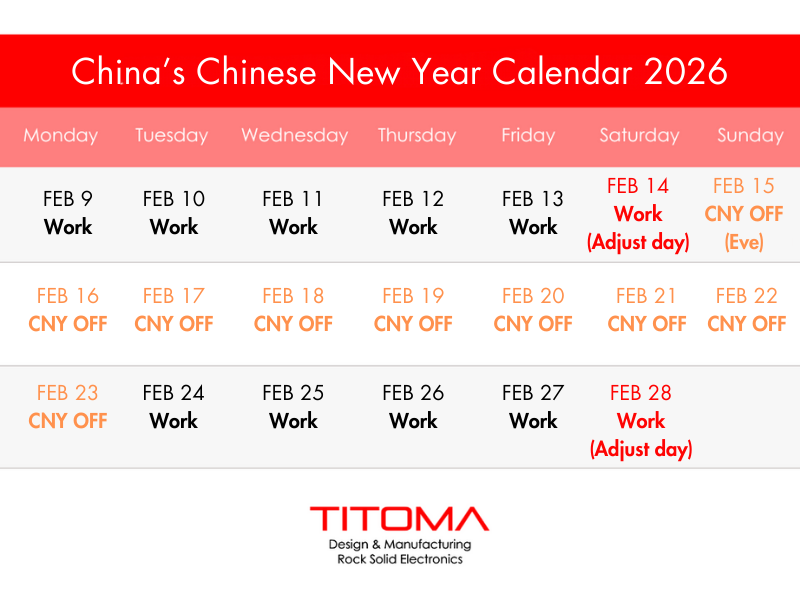
2026 Chinese New Year Calendar (China)
China and Taiwan have slight differences in their Chinese New Year holiday schedules and makeup days.
Below is the timeline for the Chinese New Year holiday in Taiwan:
- Early February: Suppliers begin to slow down production in anticipation of the upcoming holiday.
- Mid-February: Employees start leaving factories to return to their hometowns for family reunions.
- February 16: Lunar New Year’s Eve; most employees have departed, and factories are closed.
- February 17: Lunar New Year’s Day; the official start of the Chinese New Year celebrations.
- February 18 – February 21: Chinese New Year holidays continue; businesses and factories remain closed.
- Late February: Employees gradually return to work; however, production may not yet be at full capacity.
- Early March: The majority of employees have returned, and operations begin to normalize.
- Mid-March: Factories and suppliers are fully operational, with production back to standard levels.
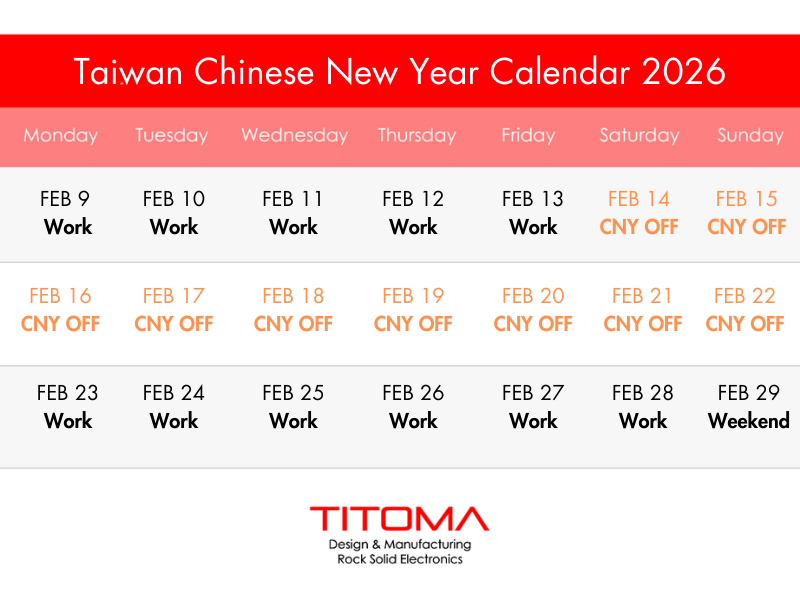
2026 Chinese New Year Calendar (Taiwan)
CONCLUSION
Chinese New Year is a unique event that puts manufacturing and supply across China and Taiwan at a standstill for at least 7 days.
In Taiwan, this is generally the extent of the delay, but in China, the effects tend to be much more severe, and you should count on 2 to 3 weeks of disruption.
Factories and their providers experience a decline in output and an increase in quality issues weeks before and after the official time of the holiday.
Because of the number of factory workers that leave early for the holidays, factories rush to finish all orders at least 10 days before the beginning of the holiday; at the same time, customers that are aware of the proximity of Chinese New Year increase their order volumes.
In many instances, the tremendous pressure imposed by the increase in demand, trying to get all orders done as soon as possible, and having many workers leave results in turning a blind eye to quality control and compliance with order specifications.
So: make sure you place your manufacturing orders well ahead of the Chinese New Year holiday!

CHINA PUBLIC HOLIDAYS 2026
The State Council has released the official public holiday schedule for China in 2026 through its Circular of the General Office of the State Council on the Arrangement of Public Holidays in 2026. Below is the list of China public holidays for 2026, including the adjusted working days:
New Year: January 1, 2026
Spring Festival (Chinese New Year): February 15 to February 23, 2026
- Employers are encouraged to arrange paid leave for employees on Chinese New Year’s Eve (February 15)
- Adjusted working days: February 14, 2026 (Saturday) and February 28, 2026 (Saturday)
Tomb Sweeping Festival (Qing Ming Festival): April 3 to April 5, 2026
- There are no adjusted working days associated with this holiday period.
Labor Day: May 1 to May 3, 2026
- Adjusted working days: April 25, 2026 (Saturday)
Dragon Boat Festival: June 19 to June 21, 2026
Mid-Autumn Festival + National Day Combined Holiday: October 1 to October 7, 2026
- Adjusted working days: September 27, 2026 (Sunday) and October 10, 2026 (Saturday)
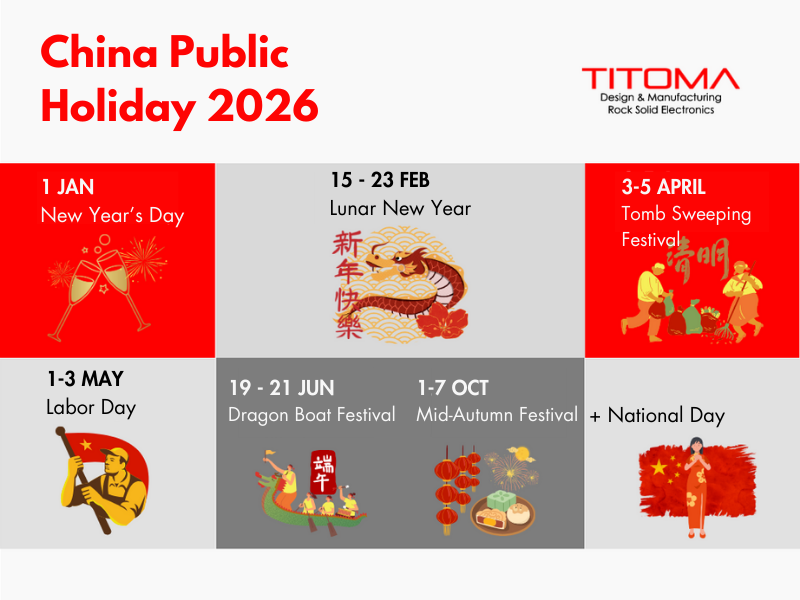
China public holidays 2026
TAIWAN PUBLIC HOLIDAYS 2026
Taiwan has different public holidays compared to China. One key difference is that Taiwan doesn’t have Golden Week. Here’s a list of Taiwan public holidays 2026, along with the adjusted working days:
New Year: January 1, 2026
Spring Festival (Chinese New Year): February 14 to February 22, 2026
- Adjusted working day: February 7, 2026
Peace Memorial Day: February 27 to March 1, 2026
Tomb Sweeping Festival (Qing Ming Festival): April 3 to April 6, 2026
Dragon Boat Festival: June 19 to June 21, 2026
Mid-Autumn Festival: September 25 to September 28, 2026
National Day: October 9 to October 11, 2026
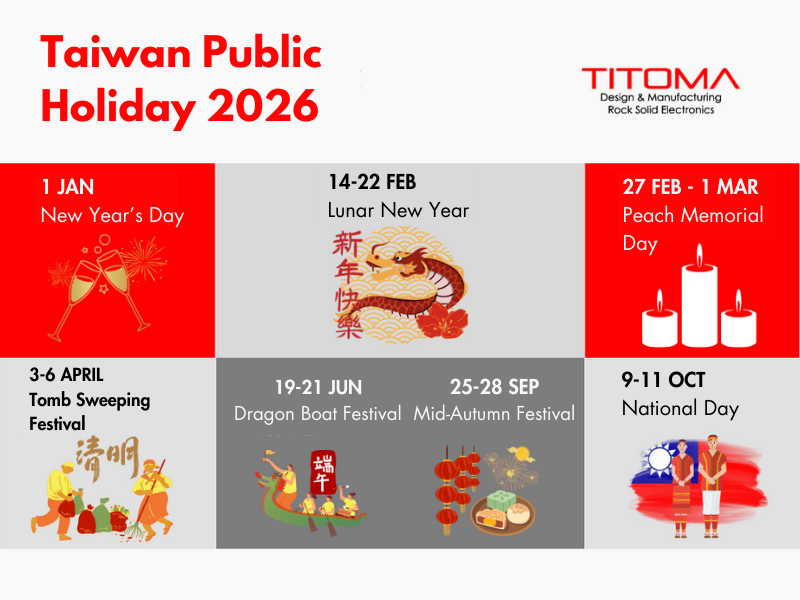
Taiwan public holidays 2026
FAQ (FREQUENTLY ASKED QUESTIONS)
Factories in China and Taiwan close for at least 7 days.
Depending on the Chinese New Year date on the lunar new calendar, workers could easily extend their holidays for more than 7 days, as it was the case in 2023 in Taiwan.
In 2026, in Taiwan, the official holiday takes place from February 14th to February 22nd, with only one working day scheduled immediately after the holiday: February 24th (Tuesday), since February 23rd (Monday) is part of a long weekend extension, allowing many workers to easily have a 9-day holiday.
Be aware that slowdowns in production will begin from 1 to 2 weeks ahead of the Chinese New Year holiday, and will remain 1 to 2 weeks after it.
In China, factories and offices will shut down from February 15th to February 23rd, 2026.
In Taiwan, all offices and factories will shut down from February 14th to February 22nd, 2026.
Chinese New Year factory shutdowns, officially, take place during the third week of February.
In 2026, the official dates for Chinese New Year’s closings in China are February 15th to February 23rd, 2026.
In Taiwan, Chinese New Year’s closings during 2026 will take place from February 14th to February 22nd, 2026.
The official dates for Chinese New Year in China are February 15th to February 23rd. For Taiwan, the official dates are from February 14th to February 22nd.
The manufacturing shutdown during Lunar New Year 2026 will last from February 15th to February 23rd in China. In Taiwan, the manufacturing shutdown will last from February 14th to February 22nd. Disruption in manufacturing is expected to begin 1–2 weeks before the official dates and remain ongoing 1–2 weeks after the end of the holiday.