
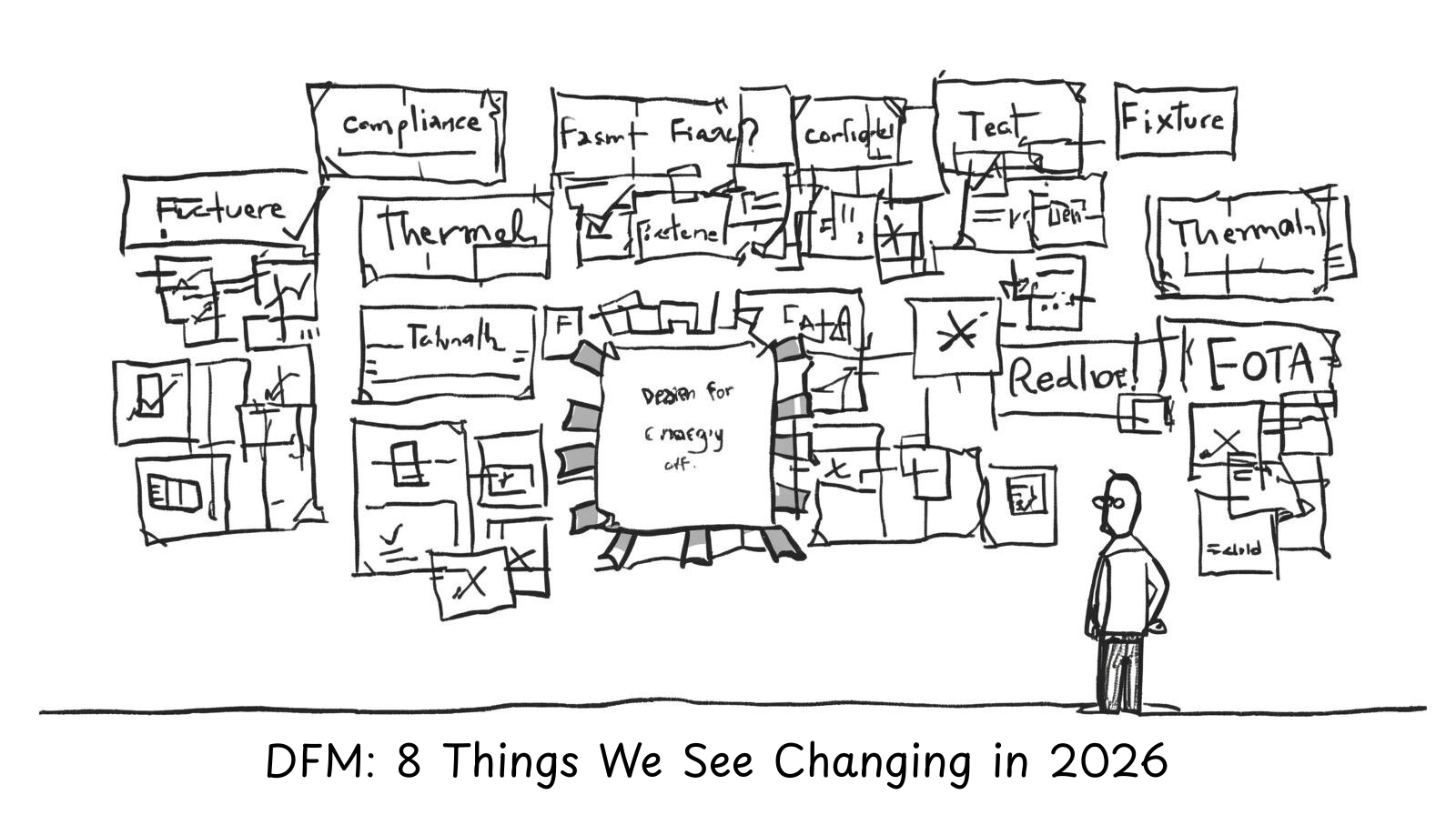
Design for Manufacturing (DFM) in 2026 starts before the architecture is frozen—not after the first prototype fails. Manufacturing choices now affect cybersecurity, product updates, component availability, regulatory compliance, test data, and the ability to transfer production between factories.
The goal is still straightforward: build the right product reliably, at the required volume and cost. What has changed is the number of decisions that must be made early. A PCB may be electrically correct and still create problems if it cannot be tested, updated securely, sourced for five years, or assembled consistently by the intended factory.
These are the eight biggest electronics DFM trends we see shaping product development in 2026.
1. DFM Starts Before the Architecture Is Frozen
DFM once meant reviewing Gerbers, drawings, and tolerances near the end of development. In 2026, the most valuable DFM decisions happen while the team is still choosing the product architecture.
Early decisions determine enclosure size, connector access, thermal paths, antenna clearance, assembly sequence, programming method, test-point coverage, and whether the product can be repaired. Waiting until layout is complete turns many of these into expensive compromises.
A useful early review includes electrical, mechanical, firmware, test, sourcing, compliance, and factory representatives. Simulation and automated checks help, but they do not replace a review against the actual equipment, operators, materials, and process limits of the intended manufacturer.
See why early supplier involvement improves DFM.
2. Test Fixtures Become Part of the Product System
Production test is no longer a fixture added after design verification. The interface between the device, firmware, fixture, and manufacturing database must be planned together.
Modern fixtures identify each unit, load the correct firmware, run electrical and functional tests, record measurements, and return a clear pass or failure code. Useful records include serial number, hardware revision, firmware version, fixture ID, calibration status, measured limits, rework history, and operator or station information.
This data makes failures reproducible and allows engineers to separate a design issue from a component lot, fixture problem, or process drift. IPC-2591 Connected Factory Exchange (CFX) supports standardized manufacturing communication for applications including traceability, live dashboards, and closed-loop feedback.
Official reference: IPC-2591 CFX.
3. Compliance and Cybersecurity Move Into DFM
Compliance affects hardware architecture, not only the documents submitted before launch. Market requirements can change the charging interface, power design, labeling, materials, radio configuration, memory size, logging, and update process.
Two 2026 examples make this clear:
- EU common-charger rules now cover laptops. Since April 28, 2026, covered laptops capable of wired charging must meet the applicable USB-C and USB Power Delivery requirements. A late change can affect connectors, power-path design, enclosure tooling, PCB layout, and packaging.
- EU Cyber Resilience Act reporting begins September 11, 2026. Manufacturers of products with digital elements must report actively exploited vulnerabilities and severe security incidents within defined time limits. Products therefore need ownership, version records, secure update capability, and an operational vulnerability process.
Official references: the European Commission’s common-charger guidance and Cyber Resilience Act reporting guidance.
4. Power and Thermal Budgets Are Verified Earlier
Low power is no longer only a battery-life feature. It influences enclosure temperature, power-supply size, charging time, radio performance, reliability, and regulatory testing.
Teams increasingly define power states and thermal limits before the schematic is complete. They measure startup, transmit, processing, sleep, charging, and fault conditions rather than relying on typical values from datasheets. Firmware duty cycles are then tested on real hardware during early prototypes.
DFM reviews should also check whether production can verify the most important power modes. A device that passes functional test but consumes too much current in sleep can still fail in the field. Energy-profiling tools from MCU vendors help teams connect firmware events to current consumption, but the acceptance limits must be defined by the product team.
5. BOM Decisions Include Lifecycle and Geopolitical Risk
Price and availability at prototype quantity are not enough. A production-ready BOM needs lifecycle status, approved alternates, package compatibility, lead-time risk, country of origin, export-control considerations, and a plan for end-of-life notices.
The most effective teams classify components by replacement difficulty. A resistor alternate may require a documentation update, while a processor, radio module, display, or custom connector may require firmware work, compliance retesting, tooling changes, or a new enclosure.
That is why sourcing and engineering must share the same revision-controlled BOM. Alternatives should be evaluated before a shortage, not approved under schedule pressure. Read more about smart BOM sourcing and lifecycle planning.
6. Multi-Sourcing Requires Design Portability
Adding a second supplier name to a spreadsheet does not create a portable design. A product can move between factories only when the manufacturing knowledge is controlled and transferable.
A portable package includes:
- complete Gerbers, ODB++ or IPC-2581 data, drawings, and controlled BOMs;
- approved component alternates and substitution rules;
- fixture drawings, software, calibration instructions, and golden units;
- firmware programming, key-injection, and serialization procedures;
- work instructions, process limits, inspection criteria, and repair rules;
- known-good yield and test data for comparison during transfer.
Design portability also affects architecture. Standard interfaces, separable modules, programmable options, and documented dependencies make it easier to change a component or production location without redesigning the whole product.
7. Secure Firmware Updates Shape the Hardware
Firmware Over-the-Air (FOTA) is not simply a software feature. A reliable update system needs hardware resources and a factory process.
The design may require memory for two firmware images, a protected bootloader, rollback capability, cryptographic key storage, a recovery interface, stable power during updates, and a way to identify the installed version. Production must provision identities and keys without exposing them to unauthorized users or leaving shared default credentials.
NIST’s updated 2026 guidance for IoT product manufacturers treats cybersecurity as a lifecycle activity from pre-market development through support and end of life. NIST’s device capability catalog also calls for software updates to be performed only by authorized entities through a secure, configurable mechanism.
Official references: NIST IR 8259 Revision 1 and the NIST software-update capability catalog.
8. Production Data Feeds Back Into Design
The traditional one-way handoff from engineering to manufacturing is too slow for connected electronics. In 2026, useful production data flows back into design, sourcing, firmware, and quality decisions.
First-pass yield, defect codes, test distributions, rework, component lots, and station performance can reveal problems before they become customer returns. The goal is not to collect every possible measurement. It is to capture data that has a defined owner, limit, reaction plan, and revision context.
For example, a gradual change in radio output may point to an antenna assembly issue, while failures linked to one component lot may trigger a sourcing action rather than a PCB redesign. The team must preserve the relationship between unit serial number, product revision, BOM revision, firmware version, and test result.
Learn more about how manufacturing feedback improves DFM reviews.
DFM Checklist for Electronics Teams in 2026
- Has the intended factory reviewed the architecture before layout freeze?
- Are assembly sequence, access, tolerances, thermal paths, and antenna clearances documented?
- Can every unit be programmed, serialized, tested, and traced efficiently?
- Are power states and thermal limits measured on real hardware?
- Does the BOM include lifecycle status and technically approved alternatives?
- Can fixtures, firmware tools, and manufacturing knowledge move to another factory?
- Are secure boot, update, rollback, recovery, identity, and key provisioning planned?
- Do compliance requirements match every target market and product variant?
- Does production data link to hardware, BOM, firmware, and test revisions?
- Is there an owner and reaction plan for each critical manufacturing metric?
Conclusion
The biggest DFM change in 2026 is that manufacturability can no longer be separated from compliance, cybersecurity, sourcing, firmware, and lifecycle support. Decisions made before the first PCB layout now determine whether a product can be built, tested, updated, transferred, and supported reliably.
The strongest teams involve the factory early, design production test with the product, control their manufacturing knowledge, and use real production data to improve the next revision. This reduces late rework and creates electronics that remain manufacturable after the first successful build.