
Last updated: October 2026
Semiconductors power everything from industrial controls and medical devices to smartphones, vehicles, and AI data centers. But “largest chip company” can mean two different things: the company that physically fabricates the wafer, or the company that designs and sells the semiconductor.
This update separates those two layers. The first ranking covers commercial chip foundries—the companies that manufacture wafers for customers. The second covers semiconductor vendors or brands, including fabless designers such as NVIDIA and AMD as well as integrated device manufacturers (IDMs) such as Samsung, SK hynix, Intel, and Micron.
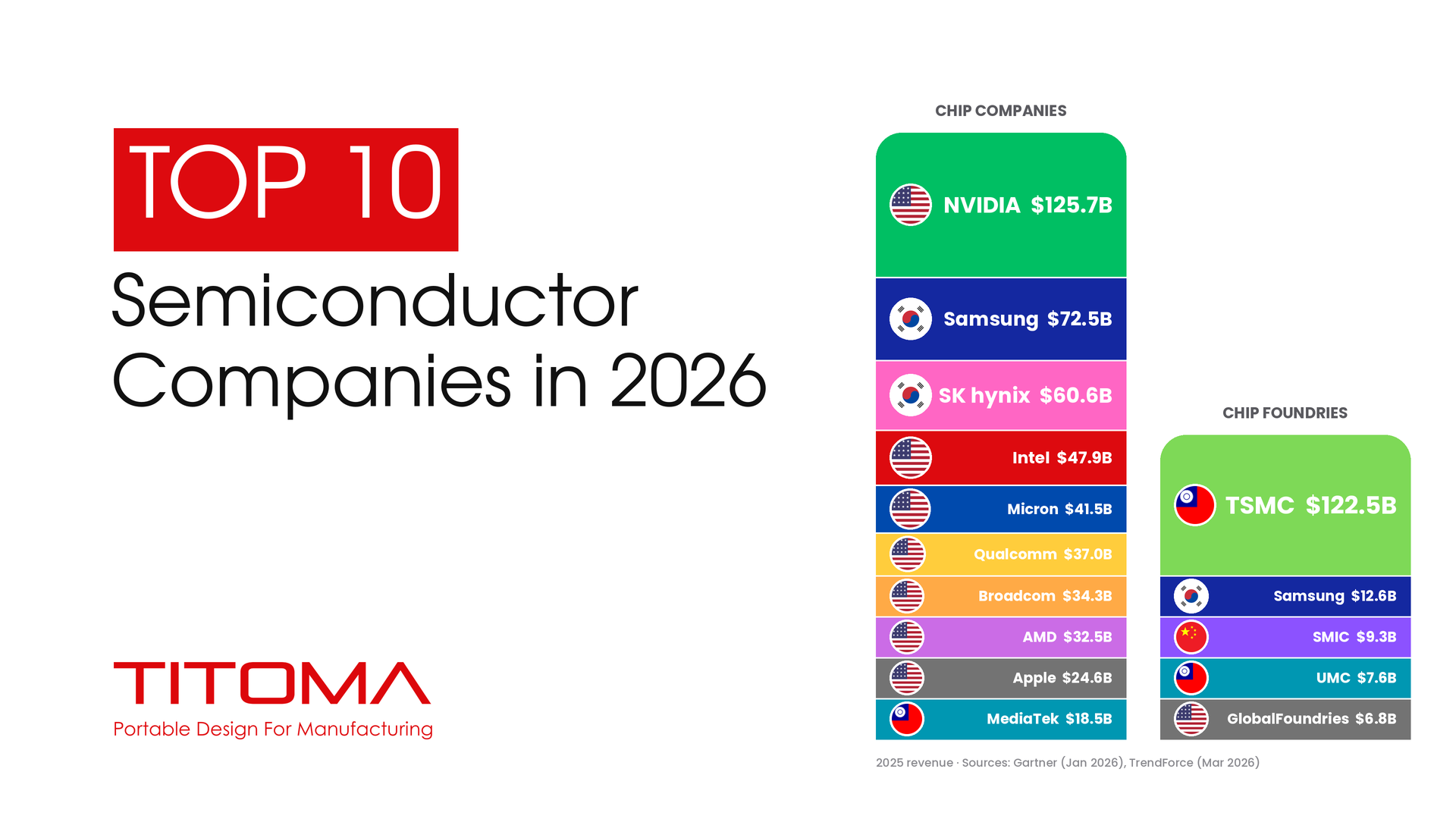
Using the latest complete year, TSMC led the foundry market with $122.5 billion in 2025 revenue and 69.9% share. NVIDIA led semiconductor vendors with $125.7 billion in calendar-2025 semiconductor revenue and 15.8% share. The two figures look similar, but they measure different markets and should not be combined into one ranking.
How we ranked the companies
For chip manufacturing, we use TrendForce’s calendar-2025 foundry revenue. This covers revenue earned by fabricating chips for customers. It includes Samsung’s foundry division but excludes Samsung’s memory and System LSI revenue. It also excludes semiconductor equipment companies and assembly-and-test providers.
For semiconductor brands, we use Gartner’s preliminary calendar-2025 vendor revenue. This includes fabless companies, IDMs, and captive chip designers. Gartner’s common calendar-year method is preferable to mixing corporate fiscal years—for example, NVIDIA closes its fiscal year in late January, while Broadcom also has a large software business.
Top 10 chip foundries in 2026
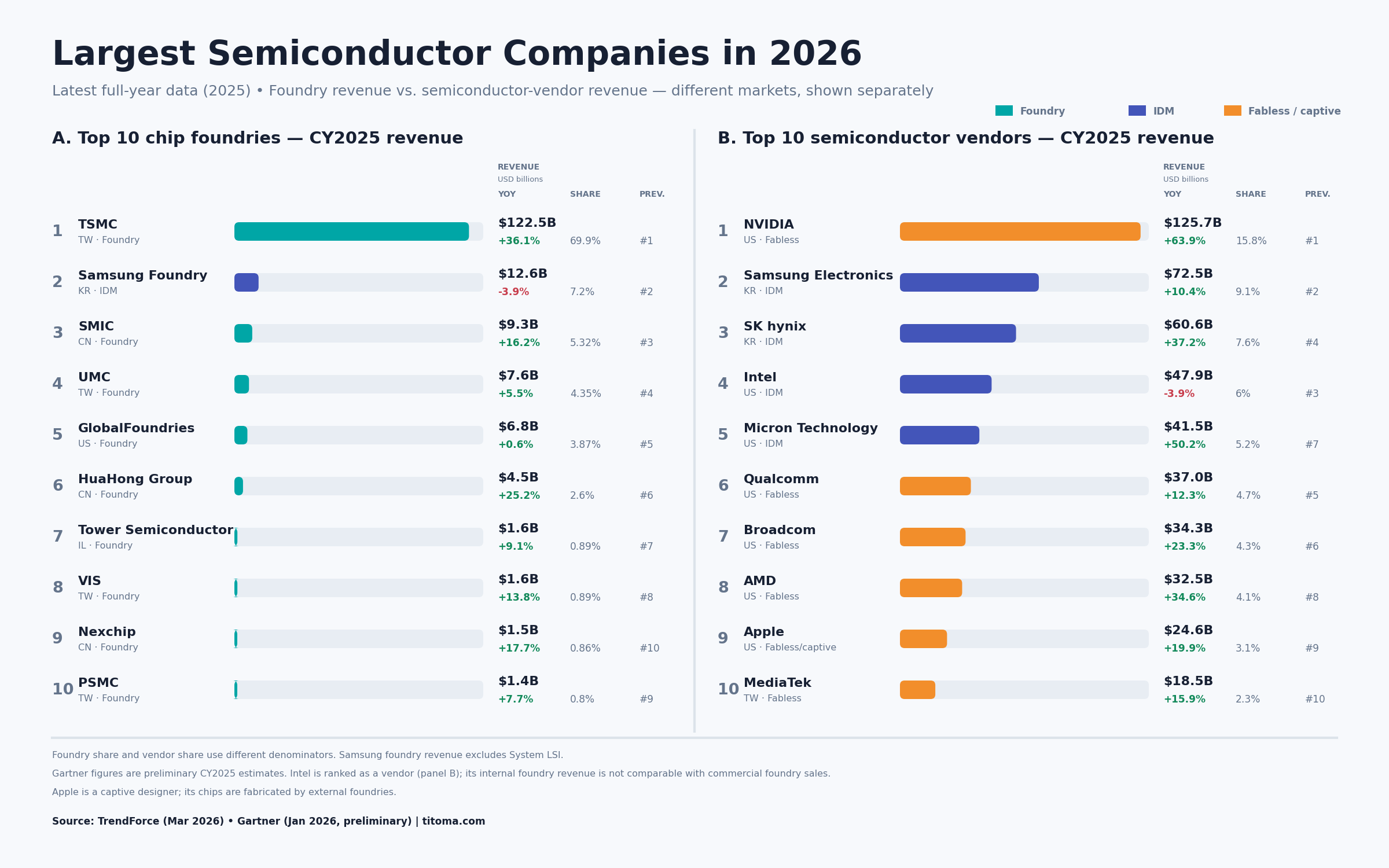
TSMC widened its lead in 2025. Its foundry revenue increased 36.1% to $122.5 billion, giving it 69.9% of the market tracked by TrendForce. Samsung Foundry remained second at $12.6 billion, while China-based SMIC held third place at $9.3 billion.
HuaHong Group, Nexchip, and SMIC all recorded double-digit growth as China’s localization push supported domestic wafer demand. Nexchip moved ahead of PSMC, the only change in the annual top-10 order.
| Rank | Company | HQ | Model | 2025 foundry revenue | YoY | Foundry share | 2024 rank |
|---|---|---|---|---|---|---|---|
| 1 | TSMC | Taiwan | Foundry | $122.543B | 36.1% | 69.9% | 1† |
| 2 | Samsung Foundry | South Korea | IDM — foundry division only | $12.634B | −3.9% | 7.2% | 2† |
| 3 | SMIC | China | Foundry | $9.327B | 16.2% | 5.32% | 3† |
| 4 | UMC | Taiwan | Foundry | $7.629B | 5.5% | 4.35% | 4† |
| 5 | GlobalFoundries | United States | Foundry | $6.791B | 0.6% | 3.87% | 5† |
| 6 | HuaHong Group | China | Foundry | $4.500B | 25.2% | 2.6% | 6† |
| 7 | Tower Semiconductor | Israel | Foundry | $1.566B | 9.1% | 0.89% | 7† |
| 8 | Vanguard International Semiconductor (VIS) | Taiwan | Foundry | $1.561B | 13.8% | 0.89% | 8† |
| 9 | Nexchip | China | Foundry | $1.514B | 17.7% | 0.86% | 10† |
| 10 | PSMC | Taiwan | Foundry | $1.404B | 7.7% | 0.80% | 9† |
† Derived by ordering the 2024 revenue column in TrendForce’s image: TSMC $90.047B; Samsung $13.152B; SMIC $8.030B; UMC $7.234B; GlobalFoundries $6.750B; HuaHong Group $3.595B; Tower $1.436B; VIS $1.371B; PSMC $1.304B; and Nexchip $1.286B.
Source: TrendForce, March 2026
Top 10 semiconductor companies by revenue in 2026
NVIDIA remained the world’s largest semiconductor vendor in Gartner’s calendar-2025 ranking. Its semiconductor revenue increased 63.9% to $125.7 billion—$53.2 billion more than Samsung Electronics in second place.
The biggest rank changes came from memory. SK hynix rose to third as demand for high-bandwidth memory used in AI servers lifted revenue 37.2%. Micron climbed from seventh to fifth with 50.2% growth. Intel slipped to fourth and was the only top-10 company with lower semiconductor revenue in 2025.
| Rank | Company | HQ | Model | CY2025 semiconductor revenue | YoY | Vendor-market share | 2024 rank |
|---|---|---|---|---|---|---|---|
| 1 | NVIDIA | United States | Fabless | $125.703B | 63.9% | 15.8% | 1 |
| 2 | Samsung Electronics | South Korea | IDM | $72.544B | 10.4% | 9.1% | 2 |
| 3 | SK hynix | South Korea | IDM | $60.640B | 37.2% | 7.6% | 4 |
| 4 | Intel | United States | IDM | $47.883B | −3.9% | 6.0% | 3 |
| 5 | Micron Technology | United States | IDM | $41.487B | 50.2% | 5.2% | 7 |
| 6 | Qualcomm | United States | Fabless | $37.046B | 12.3% | 4.7% | 5 |
| 7 | Broadcom | United States | Fabless | $34.279B | 23.3% | 4.3% | 6 |
| 8 | AMD | United States | Fabless | $32.484B | 34.6% | 4.1% | 8 |
| 9 | Apple | United States | Fabless/captive designer | $24.596B | 19.9% | 3.1% | 9 |
| 10 | MediaTek | Taiwan | Fabless | $18.472B | 15.9% | 2.3% | 10 |
Source: Gartner, January 2026 (preliminary)
Other key players: equipment and packaging
Several companies in the old ranking remain essential to semiconductor production, but they operate in different parts of the value chain and should not be ranked against foundries or chip vendors. ASML and Applied Materials manufacture wafer-fabrication equipment rather than ICs. The same category includes Lam Research, whose systems are used for deposition and etching, and Tokyo Electron, which supplies coating, cleaning, deposition, and other production equipment.
ASE Technology belongs to another critical layer: outsourced semiconductor assembly and test, or OSAT. It packages fabricated dies, provides advanced packaging services, and tests finished devices before shipment. These equipment and packaging specialists influence manufacturing capacity, process capability, yield, and time to market, but their revenue is not semiconductor-vendor revenue or commercial wafer-foundry revenue. They are therefore included here for context without being inserted into either ranking.
Key takeaways 2026
- TSMC is the dominant contract chip manufacturer, with 69.9% of 2025 foundry revenue tracked by TrendForce.
- NVIDIA is the largest semiconductor vendor, but it is fabless: foundries such as TSMC manufacture its chips.
- AI demand is lifting both compute chips and high-bandwidth memory, pushing SK hynix and Micron higher in the ranking.
- Revenue is increasingly concentrated: Omdia says NVIDIA and the three largest memory suppliers increased their combined share of semiconductor revenue from 24% in 2023 to 42% in 2025.
- “Largest chipmaker” needs a definition. Foundry revenue, vendor semiconductor revenue, corporate revenue, and market capitalization answer different questions.
What the rankings mean for electronics manufacturers
The biggest semiconductor company is not automatically the best component choice for a product. Engineers and buyers still need to consider lifecycle, lead time, package availability, second-source options, software support, compliance, and whether a part can remain available for years.
For an industrial or IoT product, component selection should be tied to PCB layout, firmware, testing, procurement, and the expected production volume. Understanding the PCB assembly process also helps teams account for package selection, inspection, testing, and production constraints before the design is frozen. During new product introduction, an early design-for-manufacturing and supply-chain review can prevent a technically suitable IC from becoming a sourcing or production bottleneck later.
Summary
The semiconductor industry’s two leaders occupy different layers of the supply chain. TSMC leads physical foundry manufacturing, while NVIDIA leads semiconductor-vendor revenue. Samsung is unusual because it participates in both: it is a major IDM and the world’s second-largest commercial foundry.
The 2025 data also shows how quickly AI is reshaping the sector. NVIDIA extended its lead, SK hynix and Micron gained rank on HBM and memory demand, and TSMC captured most foundry growth. For readers comparing suppliers, the most useful question is not simply “Who is biggest?” but “Who designs the chip, who fabricates it, and which revenue measure is being compared?”