
Most product delays do not come from big design mistakes. They come from small assumptions.
The kind you do not notice until a factory tries to build your product at speed.
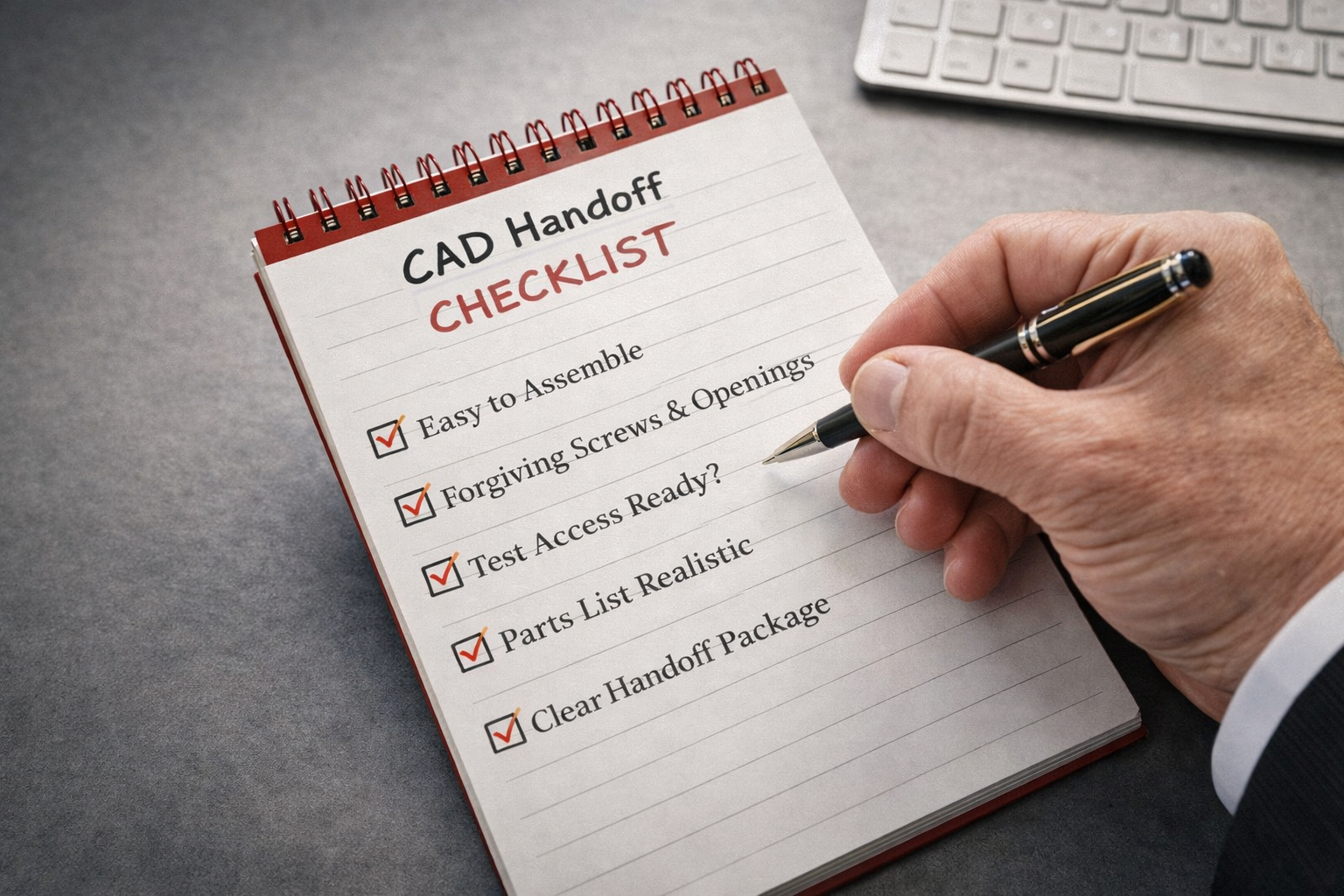
Use this five step checklist before you send CAD out. It is not a deep engineering review.
It is a fast reality check that prevents most “it doesn’t work” surprises.
Check 1 : Can a human actually assemble it
In CAD, everything goes together because nothing has hands, tools, or time pressure.
In a factory, someone has to hold parts, route cables, start screws, and close the housing without fighting it.
• Quick test
Pretend you are building it wearing thin gloves, using a standard screwdriver, and doing it 500 times a day.
If any step feels fiddly, it will become a bottleneck.
• Common fixes
Add lead ins, guiding features, and obvious part orientation. Give cables a clear path and a place to sit.
Remove steps that require “hold three things at once.”
Check 2 : Are screws and openings forgiving
If screw holes only line up when everything is perfect, you will get cross threading, cracked plastic, warped covers, and slow builds.
If ports and openings are too tight, connectors will rub or sit crooked.
• Quick test
Look for anything that needs perfect alignment. Ports, buttons, LEDs, speaker holes, screw starts, snap fits.
Ask one blunt question. If it is a little off, does it still work and still look fine.
• Common fixes
Add a little clearance where it will not be seen. Use bezels, gaskets, or trims to keep the look clean.
Make screw starts easy and make tool access obvious.
Check 3 : Can you test it without opening it again
Testing is where many builds quietly fail. Not because testing is hard, but because access is blocked.
If you need to reopen the product to program it or confirm basic functions, your cost explodes.
• Quick test
List what must be checked on every unit. Power on, charging, buttons, sensors, wireless, a quick functional test.
Then ask if you can do it when the product is fully assembled.
• Common fixes
Add access points where needed. Keep a simple programming path available at the right stage.
If you need a fixture, give it something easy to reference and clamp.
Related reading from Titoma:
DFM’s Value Is Decided on the Test Bench.
Check 4 : Is the parts list realistic
A product can be “designed” and still be impossible to build on schedule because one part is hard to buy, hard to qualify, or changes often.
You do not need perfect supply chain work at this stage. You need to avoid obvious traps.
• Quick test
Identify the top ten risk items. Custom connectors, special finishes, long lead chips, unusual batteries, one of a kind mechanical parts.
If any of these slip, does the whole project stop.
• Common fixes
Prefer common parts when possible. Approve alternates early.
If you want a simple primer, Titoma has a practical piece on reducing lead time:
How to Reduce Component Lead Time.
Check 5 : Is your handoff package clear
Factories are fast when information is clear. They slow down when they have to guess.
The most expensive problems often start with simple confusion. Wrong revision. Missing notes. Unclear orientation.
“Which one did you mean” questions that show up after the schedule is already tight.
• Quick test
Imagine a new factory has to build this without a long call with your team.
Do they have everything they need to build one unit correctly the first time.
• Common fixes
Lock revisions. Add simple assembly notes. Mark what is important. Include a few photos or annotated renders.
If there is a cosmetic requirement, say what “good” looks like.
Extra resources you can trust
If you want two solid references to back up this checklist:
• Design for Assembly basics
DFMA: What Is Design for Assembly (DFA)?
• Electronics build checklist
IPC Checklist for Printed Board Assemblies (download)
Summary
This checklist is about preventing avoidable surprises.
Make assembly simple for humans. Make screws and openings forgiving. Make testing possible without reopening the product.
Keep the parts list realistic. Hand off a clear package.
Do these five and you will cut rework, shorten build time, and reduce the number of “we need a quick design change” calls.