
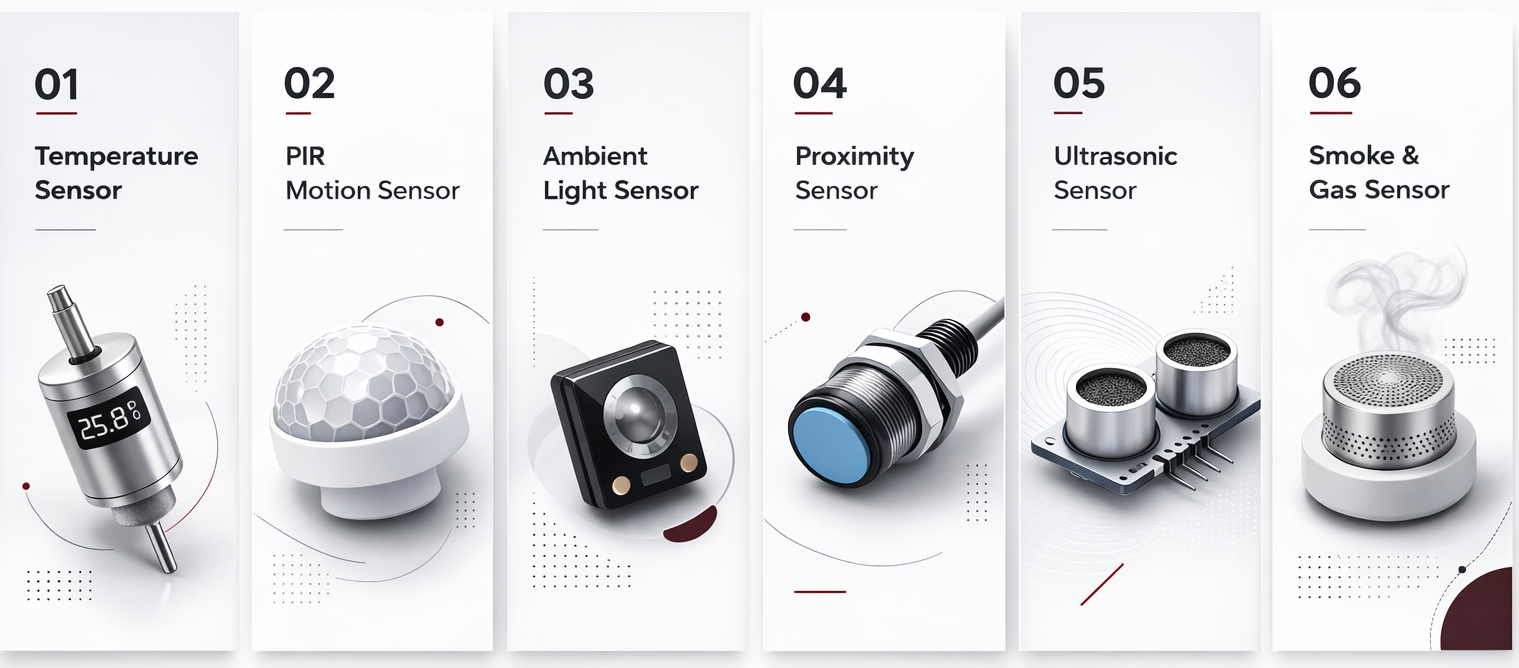
In the world of electronic product development, sensors are the interface between physical reality and digital logic. They allow a device to see, hear, or feel its environment. For a hardware entrepreneur, the challenge is not just finding a sensor that works on a breadboard. The real task is selecting a component that survives a 10-question DFM audit and fits into a scalable supply chain.
At Titoma, we have seen countless projects stall because a team chose a sensor with a 50-week lead time or one that required an impossible housing design. Choosing the right sensor is about balancing performance, cost, and manufacturability.
1. Temperature Sensors: Precision Versus Thermal Isolation
Temperature sensing is foundational to everything from medical devices to smart home climate control. While the technology is mature, the implementation often catches designers off guard.
Practical Use in Medical and Consumer Goods
You will find these in digital thermometers and smart refrigerators. In medical applications, high precision is non-negotiable. For consumer appliances, the goal is often energy efficiency through precise cooling.
The Engineering Reality
Many designers place the sensor too close to the main processor or power management IC. This mistake leads to the sensor measuring the heat of the PCB rather than the ambient environment. For high-volume production, we recommend using digital sensors with $I^2C$ interfaces. These are easier to calibrate on the factory floor than analog thermistors. When it comes to electronic component sourcing in China and Taiwan, selecting a sensor with a standard footprint ensures you can swap suppliers if shortages occur.
2. Motion (PIR) Sensors: The Power of Passive Detection
Passive Infrared (PIR) sensors are the gold standard for battery-powered IoT devices because they consume almost zero energy while in standby mode.
Use in Security and Automation
These are common in automatic mall doors and driveway security lights. They detect the infrared signatures of moving objects such as people or animals.
Mechanical Integration Challenges
A PIR sensor is not just an electronic component; it is a mechanical one. It requires a Fresnel lens to function. If your industrial design team wants a completely flat or hidden look, a PIR sensor may be a poor choice. The lens must be curved and visible to focus infrared light onto the sensor element. NASA provides a fascinating look at how infrared waves behave, which explains why these sensors cannot simply “see” through standard opaque plastics.
3. Light (LDR) Sensors: Simple but Variable
Light Dependent Resistors or Photodiodes allow a product to react to ambient light levels. They are arguably the most cost-effective sensing solution available.
Applications in UX and Infrastructure
Smartphones use these to auto-adjust screen brightness while streetlights use them to activate at sunset. This simple automation saves massive amounts of energy globally.
Sourcing for Consistency
While LDRs are incredibly cheap, they often have high variance between manufacturing batches. If your product requires consistent behavior across 100,000 units, consider a digital Ambient Light Sensor (ALS). These provide much better filtering for infrared light, ensuring the device reacts to what the human eye sees rather than invisible solar radiation. This level of consistency is a core part of optimizing your Bill of Materials (BOM) for long-term reliability.
4. Proximity Sensors: Enabling Touchless Interfaces
Proximity sensors detect the presence of an object without physical contact. This has become a baseline expectation for modern, hygienic interfaces.
Use Cases in Mobile and Automotive
Your phone uses a proximity sensor to disable the touchscreen when you hold it to your ear. In cars, these sensors provide the audible beeping that helps drivers avoid obstacles while parking.
Material Choice and Interference
You cannot choose a proximity sensor without first deciding on your product housing. Inductive sensors only work with metallic objects. Capacitive sensors can work through plastic but are sensitive to moisture. If you use an infrared proximity sensor, the front cover must be made of IR-transparent material. Failure to coordinate these choices early in the design phase will lead to expensive tooling changes later.
5. Ultrasonic Sensors: Measuring Distance with Sound
When you need to know exactly how far away an object is, sound waves are often more reliable than light. Ultrasonic sensors measure distance by timing the echo of high-frequency sound.
Specialized Use in Robotics and Industry
Drones use ultrasonic sensors to maintain a steady altitude above the ground. In industrial settings, they are used for non-contact liquid level sensing in large tanks.
Advanced Research Trends
While standard ultrasonic sensors are bulky, new research is pushing the boundaries of what is possible. For instance, MIT researchers have developed a self-powered sensor that harvests energy from its environment to operate without batteries. This highlights the industry’s direction toward ultra-low-power, “set and forget” sensing in hard-to-reach industrial environments.
6. Smoke and Gas Sensors: Regulatory and Production Hurdles
These are safety-critical components. If they fail, the consequences are severe, which means they come with heavy regulatory oversight.
Use in Home and Kitchen Safety
Smoke alarms and gas leak detectors are mandatory in most residential markets. They detect chemical particulates or specific gases like LPG and natural gas.
The Factory Burn-In Requirement
Unlike other sensors, gas sensors often require a burn-in period of 24 to 48 hours before they stabilize. When we manage production for these products, we have to build dedicated aging racks. Skipping this step in a rush to meet a deadline will lead to high return rates due to false alarms in the field. This is a classic example of why the standards set by organizations like the IEEE Sensors Council are vital for maintaining safety and reliability in hardware design.
The Bottom Line: Design for Scalability
Choosing a sensor from a datasheet is only the beginning. At Titoma, we help you choose components that are not only high-performing but also easy to source and assemble.
Would you like us to review your current sensor selection to ensure your product is ready for mass production?