
A family mold is almost always the cheapest option on paper. In practice, it depends on how many of each part you need, and some quotes leave that number out.
Take a common case. A product comes in two sizes, standard and large. The housing parts for both sizes can go into one shared family mold, or into separate molds per size.
On the quote, the family mold looks like the clear winner: about $10k cheaper to build and the lowest unit price. But suppose you sell three standard units for every large one. That one detail changes the math, and it raises engineering questions a price sheet doesn’t show.
The numbers below are examples. Use the figures from your own quote to run the same comparison.
What is a family mold?
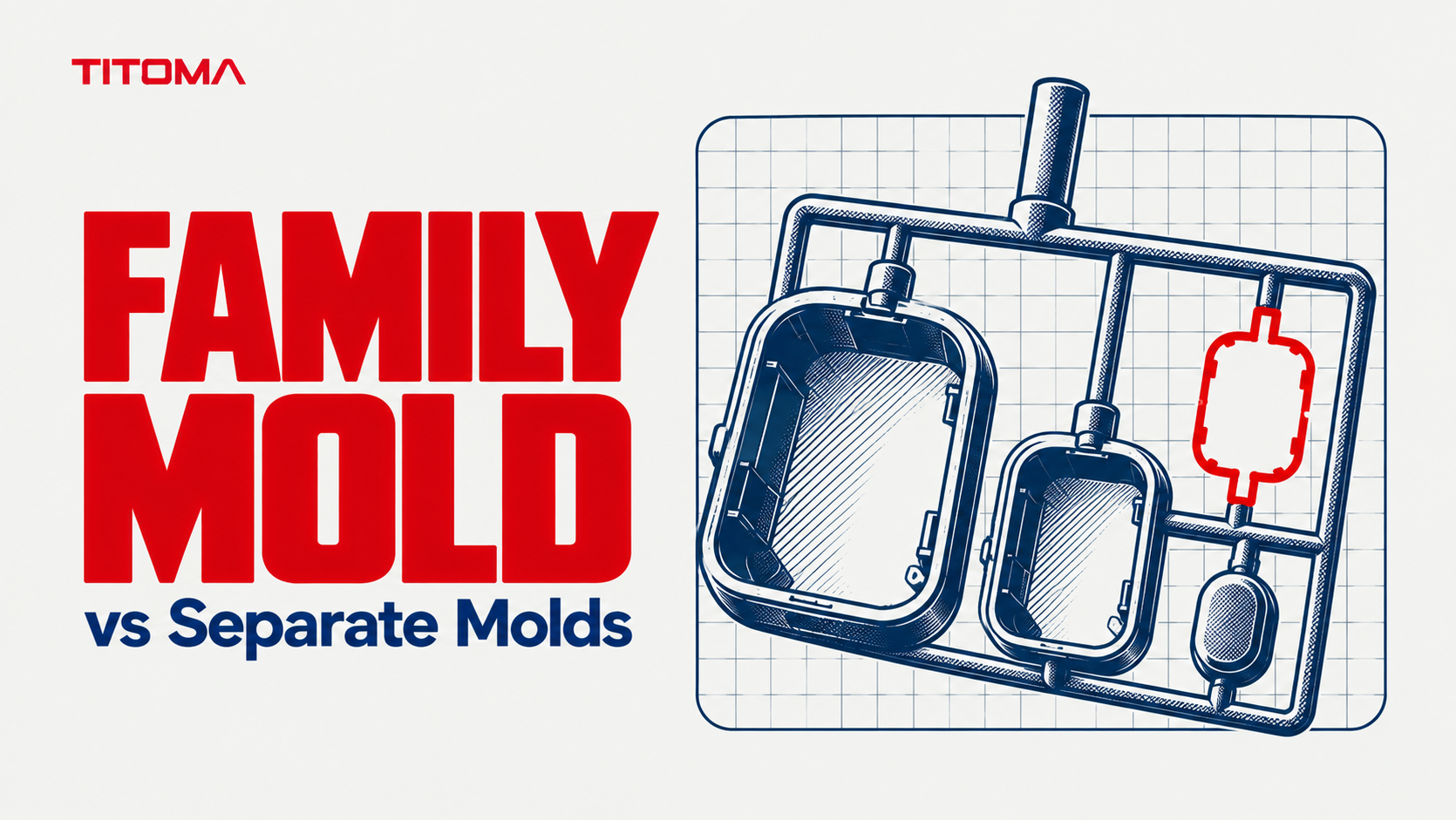
A family mold is one injection mold with cavities for different parts. Every shot produces a full “family”: for example a top cover, a bottom cover and a button, or the same part in two sizes.
The alternatives:
- Single-cavity mold: one part per shot.
- Multi-cavity mold: several copies of the same part per shot.
- Separate molds: one mold for each part or each size.
A family mold shares one mold base, one set of ejectors and one cooling layout across all the parts. That is where the tooling savings come from. The mold is often the biggest single item in a product’s non-recurring engineering costs.
You can also block cavities. The mold maker shuts off the cavities for the parts you don’t need, so you can run only one part from the shared tool. Those blocked runs cost more per unit.
The financial case: a typical quote
On price alone, the family mold wins, as long as both sizes run together. Here are three options for the plastic housing set, with illustrative numbers at 5,000 units:
| Option | Tooling (both sizes) | Unit cost per housing set |
|---|---|---|
| Family mold, both sizes run together | $40k | $2.00 |
| Separate molds | $50k | $2.30 |
| Family mold, one size blocked | $40k | $2.45 |
The family mold saves $10k on tooling. Running both sizes in the same shot also gives the lowest unit cost by $0.30.
Blocking cavities changes that. Run only one size and the same family mold becomes the most expensive option per unit, more than 20% above running both sizes together and more than separate molds. You pay for a large tool and a full machine cycle, but only use part of it.
Your sales mix decides the real cost
A family mold only runs at its lowest cost when you need equal numbers of every part. With a 3:1 sales mix, only some production runs can use the full mold. The extra standard units have to be made with the large cavities blocked, at the higher price.
Averaged over all units, the family mold still comes out about $0.08 cheaper per unit at a 3:1 mix. The gap shrinks as the mix gets more uneven, and disappears at around 5:1.
The rule of thumb: compare options using your expected sales mix, not a 1:1 assumption. Your break-even point depends on your own quote, so run the numbers. In this example, below about 5:1 the family mold stays cheaper per unit and also saves $10k in tooling. Above that, separate molds become the cheaper option.
The engineering case for separate molds
Even when the family mold wins on cost, engineers often prefer separate molds, for five reasons.
Stabilization is harder. Getting a mold to produce good parts means adjusting steel and tuning temperature, pressure, injection time and cooling time. In a family mold, every change affects both sizes at once. The settings have to work for two different parts, so it usually takes more trial runs. Uneven filling across different-sized cavities is a known enough problem that IKV Aachen has studied it in a research project on controlling pressure per cavity in family molds.
Good samples come faster. With separate molds, each tool can be tuned for its own part. That usually gets you approved samples sooner.
You can learn one size first. The team can focus on the standard size, get it stable, then apply what they learned to the large one. Both tools can still start together, so the launch date doesn’t have to move.
Changes are cheaper later. If the design or material changes after launch, you only modify the tool that needs it. In a family mold, a change to one part can disturb the balance of the whole tool. That is one more reason to settle the design through a design for manufacturing review before any steel is cut.
A repair stops every part. If a family mold needs repair, you lose production of every part in it.
On the overall timeline, the two options often end up close. Separate molds can come out slightly ahead because they stabilize faster.
Family mold or separate molds? A quick checklist
Finance and engineering often point in opposite directions. In the example above, the family mold wins on cost and separate molds win on risk. Use this table to see which way your project leans.
| Question | Leans family mold | Leans separate molds |
|---|---|---|
| How close is your sales mix between the parts? | Close to 1:1 | Very uneven |
| How tight is the tooling budget? | Every $10k matters | Tooling is a small share of the project |
| Are the parts similar in size, wall thickness and material? | Yes | No |
| How tight are the tolerances or cosmetic requirements? | Moderate | Tight |
| Could the design or material still change? | Design is frozen | Changes are likely |
| How critical is getting stable samples fast? | Some slack in the schedule | Every week counts |
| Can production stop if one tool needs repair? | Yes, briefly | No |
If most of your answers land in one column, that is your direction. If they split, ask your manufacturing partner to model both options with your real sales forecast, not a 1:1 assumption.
Before you sign off on tooling
Run the comparison with your real sales forecast, not a 1:1 split. Then ask your engineers which option they would rather stabilize, and weigh that against the savings. Tooling is only one of the levers on production cost, but it is hard to undo once the steel is cut.
If you are weighing a tooling quote of your own, Titoma can help you model both options against your forecast and talk through the engineering risks. Get in touch.
