
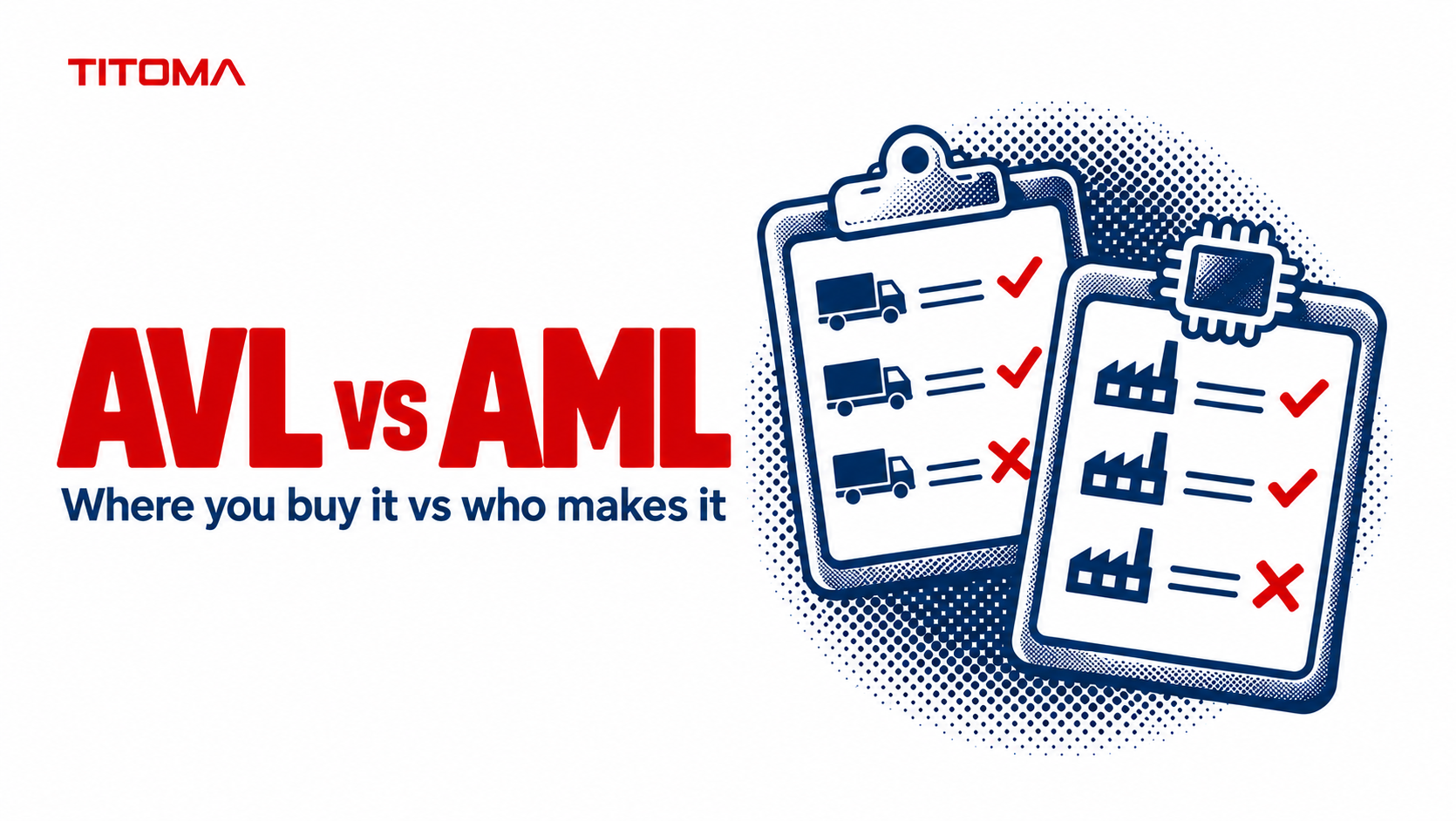
An approved manufacturer list (AML) names which manufacturers’ parts are allowed for each electronic component on a bill of materials. An approved vendor list (AVL) names where those parts may be bought. Some companies use the terms interchangeably, so define both lists with your contract manufacturer before anyone places a purchase order.
How Do AVL and AML Compare at a Glance?
| Factor | AML | AVL |
|---|---|---|
| What it lists | Approved component manufacturers and exact part numbers | Approved purchasing sources, such as authorized distributors |
| Answers | Which part is acceptable? | Where may we buy it? |
| Usually owned by | Engineering | Procurement or sourcing |
| Changed through | Engineering change process | Supplier qualification |
| Main risk it controls | Unapproved substitutes | Counterfeit or untraceable parts |
That separation is a useful working rule, not a universal vocabulary standard. PTC’s Windchill terminology distinguishes approved manufacturer parts from approved vendor parts, while Arena’s manufacturing glossary likewise separates part approval from purchasing-source approval. Other organizations label their records differently. What matters is that the factory can tell both which component to fit and where it may obtain it.
What Is an Approved Manufacturer List (AML)?
An AML connects an internal item on your bill of materials to the manufacturer names and manufacturer part numbers (MPNs) that engineering has approved for that item. A line saying only “10 µF capacitor, 16 V” is a specification, not an approval decision. Different parts can meet those headline figures yet differ in package dimensions, dielectric, tolerance, temperature behavior, or availability.
For each BOM item, record the primary MPN and any qualified alternates. Include the package, grade, revision, and application restrictions where they matter. If a particular connector pin finish or microcontroller memory option is required, capture the complete ordering code. A near match from the same manufacturer can still be the wrong part.
Second sources reduce dependence on one manufacturer, but “equivalent” requires review and testing. Electrical ratings, footprint, firmware behavior, thermal performance, and assembly conditions may all need checking. Design-stage choices are easier to qualify during design for manufacturing than after production settings are fixed.
The product owner should approve the AML, even when a contract manufacturer proposes parts. Engineering knows the design margin and intended use; a buyer looking at stock and price does not. Procurement can flag a shortage and request a second source, but the request should not become permission to install that part on the next build.
What Is an Approved Vendor List (AVL)?
An AVL identifies the sellers permitted to supply components. In this article, a vendor is a purchasing source: the original component manufacturer, an authorized distributor, or another specifically approved supplier. Approval can be scoped by part family, region, site, or customer program. A seller approved for standard passives need not be approved for a scarce processor bought through a different channel.
Buying an AML-approved MPN from an unapproved broker does not make the purchase safe. The marking on the package may be right while the chain of custody is missing. Conversely, an authorized distributor can offer a real component whose MPN is absent from your AML. The AVL cannot turn that component into an approved design substitute.
Authorized distribution generally offers a clearer route back to the original manufacturer. Independent distributors can be useful when authorized stock has disappeared, but their material calls for a separate risk decision: provenance, lot and date-code records, inspection, testing, and customer approval where required. SAE AS5553E addresses counterfeit-part risk controls for organizations that procure and integrate electronic parts, including contract assemblers. SAE AS6081A addresses avoidance, detection, mitigation, and disposition in independent distribution. Neither standard is a shortcut for qualifying a different MPN for your design.
SAE also has a separate AS6496A standard for authorized distribution. That distinction is useful when a supplier claims a certification: ask which standard, which legal entity and site it covers, and whether the offered stock has traceability to the original manufacturer.
Why Do Some Companies Treat AVL and AML as the Same Thing?
The terminology grew out of different PLM systems and purchasing practices. Some teams use “vendor” to mean the company that made a component; others mean the distributor that sold it. A combined approved-source table may contain both MPNs and sellers under a single AVL heading. The label alone cannot tell you which control the table enforces.
This is a real disagreement, not a typo in one system. PTC and Arena use separate manufacturer and vendor concepts, but a PLM guide to purchased parts explicitly describes one qualified-source list as being called either AML or AVL. Its list identifies approved manufacturer part numbers, which is the function this article calls an AML.
When you send a BOM to a factory, define the columns in writing: “AML = approved manufacturer plus exact MPN for each internal part; AVL = approved purchasing sources.” If your PLM export calls both an AVL, add separate fields for manufacturer/MPN approval and supplier approval. Specify who can change each field and what evidence is required.
What Happens When Your Manufacturer Buys Parts Not on Your AML?
The immediate risk is an unapproved substitute on the board. A factory may see a matching description and choose the cheapest available MPN. It might pass a basic electrical test yet behave differently over temperature, fail a regulatory test, or be mechanically incompatible during assembly. Even a genuine part from a reputable distributor is wrong if it was never qualified for that BOM position.
Another problem is lot mixing. If the BOM does not specify permitted MPNs and the factory combines several nominally similar parts under one internal number, a later failure becomes hard to trace. You need records that connect each finished lot or serial range to its actual MPN, supplier, lot, and date code. Without them, a narrow containment action can turn into a broad hold.
Counterfeit risk rises when the purchasing source is unknown or has weak traceability. The AML and AVL address different sides of that problem, while incoming quality control checks what actually arrives. Incoming inspection can catch discrepancies, but it cannot retroactively approve a substitute or recreate a missing chain of custody.
If an exception is discovered during a build, quarantine the affected material and identify which work orders used it. Compare the physical parts and purchasing records with the released BOM, then have engineering decide whether testing can support a controlled deviation or whether rework is needed. Do not silently update the spreadsheet to match the board.
How Do AML and AVL Connect to EOL and Engineering Changes?
When a component reaches end of life, the original MPN may remain technically approved while its supply dries up. Sourcing should first confirm the manufacturer’s notice, last-time-buy dates, authorized inventory, and forecast demand. A new distributor for the same MPN changes the sourcing route; a different MPN changes the design’s approved part choices.
Adding that alternative to the AML should go through an engineering change order or the equivalent controlled process. Record the comparison, tests, approvers, effective date or lot, and treatment of existing stock. If the alternate needs a different footprint, firmware setting, or process condition, revise the relevant drawings and instructions as well. The factory should know exactly when the new MPN becomes valid.
The AVL may change in parallel if an approved source cannot supply the alternate. Procurement can qualify a new source and set traceability requirements, but that work does not replace engineering approval of the part itself. Keeping the decisions separate makes a shortage response faster because each team knows which question it owns.
How Should You Set Up AML and AVL With a Contract Manufacturer?
Send the released AML alongside the BOM, not after the factory has priced and ordered the parts. When requesting quotes, ask the manufacturer to price the approved MPNs and identify any unavailable line separately. Otherwise a low quote may depend on a substitute you would never approve.
- Define each BOM line: internal part number, description, primary manufacturer and exact MPN, approved alternates, quantities, and any restrictions.
- Set substitution authority: say whether the factory may propose alternates, who reviews them, and whether written approval is needed before purchase or placement.
- Control purchase channels: name approved sources or state the rule for buying direct and through authorized distributors. Define an exception path for independent sources.
- Require traceability: retain purchase order, supplier, manufacturer, lot and date-code information, plus applicable certificates or test records.
- Keep revisions aligned: place the current AML, AVL, BOM, and change notices under revision control, with an effective build or lot for every change.
Ask the factory to return a line-by-line exception report before committing the order. It should distinguish “approved MPN unavailable,” “approved MPN available only from an unapproved source,” and “proposed alternate MPN.” Those are three different decisions, even if they all start with the same purchasing problem.
When discussing a build with Titoma, make proposed substitutions visible against the released BOM and approval records before procurement and assembly. If you are setting up a new program, get in touch with the BOM and sourcing constraints so quoting and approval rules are clear.
