

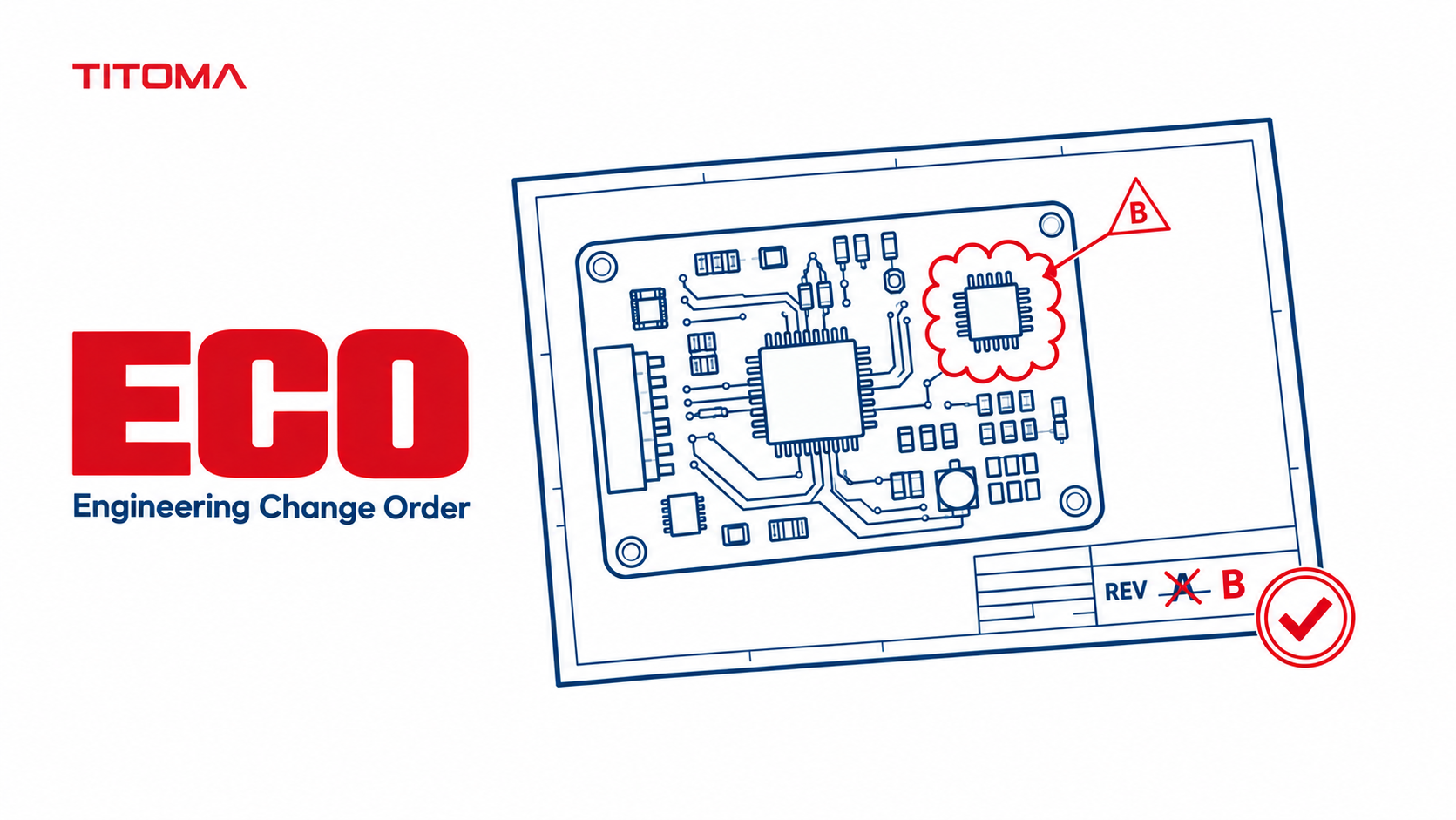
An engineering change order (ECO) is the approved document that authorizes a change to a released product design or manufacturing process. It identifies the affected items, the old and new revisions, when the change takes effect, and what happens to parts already built. In electronics manufacturing, it tells the factory which version to build.
| ECO field | What it records | Why the factory needs it |
|---|---|---|
| Affected items | Part numbers, drawings, BOM lines, and firmware versions | So related items are not missed |
| Old and new revision | Revision before and after the change | So reorders use the right files |
| Reason for change | Obsolescence, cost reduction, field failure, or compliance | So reviewers can judge the risk |
| Effectivity | Date, serial number, lot, or next purchase order | So everyone knows which units change |
| Disposition | Use as is, rework, scrap, or return existing stock | So finished and in-process units have a decision |
| Approvals | Engineering, quality, procurement, and the customer when required | So the change is authorized rather than assumed |
What Does ECO Stand For in Manufacturing?
ECO stands for engineering change order. In a factory, it is an instruction to replace an approved product or process baseline with another approved version. It is more specific than an email saying a component has changed: it connects an engineering decision to purchasing, inventory, work instructions, testing, and the next shipment.
A team may first submit an engineering change request (ECR) to propose a fix. Reviewers then assess its effect on performance, cost, schedule, inventory, and approvals. Once the change is approved, the order tells the factory what to implement. Companies use different names and software for these steps, so agree on what each document authorizes before production starts.
Configuration management is the broader discipline behind this control. SAE’s EIA-649 configuration management standard addresses change management alongside identification, status accounting, and verification. The practical point for a buyer is simple: the design files, purchase orders, and units on the line must all refer to a known revision.
What Does an Engineering Change Order Include?
The table above is a useful minimum, but an actual order should identify each changed artifact by part number and revision, with links to the released files. A PCB layout change might affect Gerbers, fabrication drawings, assembly drawings, the bill of materials, placement data, test limits, firmware, labels, and service instructions. Updating only the schematic leaves room for the old board to reappear in the next order.
The order should also identify who checked the change and on what evidence. A pin-compatible component may still need electrical, thermal, EMC, reliability, or regulatory review. Record the validation result, the approval date, and any customer sign-off required by the supply agreement. A change is not ready for purchasing merely because engineering found an alternative part.
Changes are sometimes classified as major or minor. NASA’s configuration management guidance treats a major change as one with significant effects on matters such as safety, interfaces, cost, or delivered products; a minor change does not affect product interchangeability. Class I and Class II labels appear in some controlled programs, but they are not universal approval rules for commercial electronics. Put your own approval thresholds in the manufacturing agreement and escalate any change that could affect form, fit, function, compliance, or fielded units.
What Triggers an Engineering Change in Electronics?
Component end of life is a common trigger. If a power IC is discontinued, the replacement can change the footprint, switching behavior, thermal profile, or firmware settings. Procurement may find a part with stock available today, but the change still needs engineering review and a controlled release before the factory buys or fits it.
A cost reduction can trigger the same process. Substituting a cheaper connector or reducing a PCB layer count may look harmless on a spreadsheet, yet it can affect mating cycles, impedance, assembly yield, or test coverage. Factory feedback from design for manufacturing can also justify changing land patterns, panelization, or assembly steps. Those changes belong in a released revision when they alter what the line is told to build.
Field failures, new customer requirements, and compliance findings also require controlled changes. A material change intended to meet RoHS obligations needs updated material evidence and a clear effectivity point. After EVT, DVT, and PVT validation, even a small design change can invalidate a test result if the altered feature was part of the qualification. The order should state which tests must be repeated rather than assuming an earlier pass covers the new revision.
What Is ECO Effectivity, and Why Does It Matter?
Effectivity is the point at which the approved change applies. It can be a start date, the first serial number, a production lot, or the next purchase order. For traceable products, serial or lot boundaries usually tell the clearest story. A date alone can be ambiguous if work in process was started before midnight and finished afterward.
NASA’s configuration management definitions describe effectivity as the range of units to which a change applies, expressed for example by serial or lot number. That principle transfers well to electronics production: identify both the first changed unit and the records that prove which revision each shipped unit contains. For a simple replenishment order, “begin with PO 1047” may be practical, but confirm that no old-revision work in process will be mixed into that order.
Effectivity does not answer what to do with existing stock. The order must give separate decisions for loose components, partly built boards, finished goods, and units already in the field. It might allow old units to ship as is, require rework before release, scrap a small batch, or return unused components to the supplier. These are practical disposition choices, similar to those listed in NASA’s hardware quality guidance. A safety or compliance fix may require an immediate hold and a field action; a cost-only change may be allowed to start with the next order. The decision should be explicit, including who pays for rework and how altered units will be relabeled.
Before releasing a purchase order, ask for an inventory count by part and revision. Compare it with open supplier orders and work in process. Otherwise, the team may approve a new component while the factory still has enough old stock to build another 2,000 units. That is a business decision, not a detail for a line operator to settle at the feeder.
What Goes Wrong When Engineering Changes Aren’t Controlled?
The common failure is a repeat order built from the last approved folder rather than the latest file a buyer received by email. The quote, PO, and drawing then disagree. If the mistake is found after assembly, the choice may be rework, scrap, or delayed shipment, each with a different cost and schedule impact.
Unapproved substitutions are another risk. A supplier may announce a shortage and offer an “equivalent” part, but equivalent in a distributor listing does not establish electrical behavior, package fit, traceability, or compliance. The receiving team needs the approved manufacturer part number and revision; incoming quality control can then check the delivered parts against the released list. Inspection cannot approve an engineering decision that nobody made.
Mixed revisions within one lot cause problems later, even when both versions pass end-of-line test. Service teams cannot tell which units need a field fix, and customers cannot identify a clean serial-number boundary. Segregate old and new work, update travelers and labels, and record the revision against each lot or serial number before the first changed unit ships.
ISO 9001 does not prescribe an ECO form for every factory. Its change-control principle still matters: ISO and IAF auditing guidance for the 2015 edition identifies clause 8.5.6 as calling for review and control of changes in production and service provision. A controlled revision and an implementation record provide a practical way to show what was reviewed, approved, and built.
How Should You Manage ECOs With a Contract Manufacturer?
Set the rules before the first production change. Decide whether engineering, the factory, procurement, or a component supplier may propose a change. Make clear who may approve it. A factory should be able to flag a shortage or manufacturability problem promptly, while a change affecting the customer’s design should wait for the required customer authorization before implementation.
- Require a single change record with affected part numbers, old and new revisions, reason, evidence, effectivity, stock disposition, and named approvers.
- Ask the factory to acknowledge receipt, identify the exact files loaded into its controlled system, and remove superseded shop-floor copies.
- Compare open purchase orders, supplier deliveries, work in process, and finished stock with the effectivity plan before releasing the change.
- Specify a first-article or first-lot check after the change, including the new component identity, assembly fit, firmware, and any affected test result.
- Require notice and approval for factory-initiated changes, including process, tooling, material, and subcontractor changes that could affect the product.
Close the order only after the factory records the first affected lot or serial number, confirms the new revision in its build package, and reports what happened to old stock. NASA’s change-control process guidance likewise separates approval, release, implementation, and verification. That sequence is a useful check against treating a signed PDF as proof that the line actually changed over.
When Titoma coordinates design and manufacturing for a client, the useful question is not merely whether a revision was approved. It is whether purchasing, the factory’s build package, inspection, and shipment records all point to the same revision. Ask your manufacturing partner to show that chain on the first changed batch. If any link is missing, the order is still open in practical terms.
