

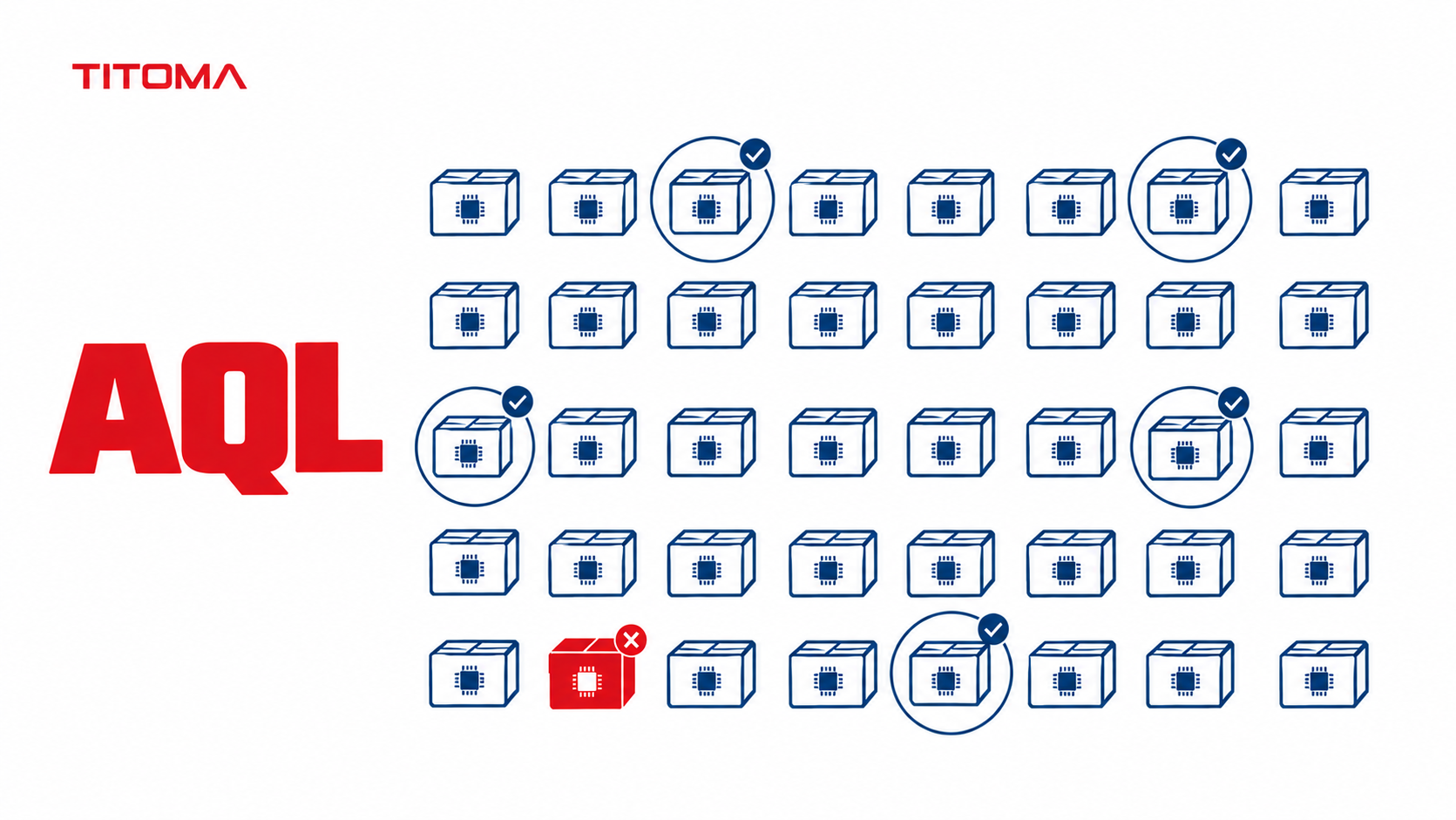
AQL (acceptance quality limit) is the worst tolerable process average used to choose an acceptance-sampling plan for a continuing series of lots. The plan sets a sample size and the number of defects that trigger rejection. In electronics, AQL sampling checks a lot before release; it cannot replace tests needed on every unit.
| Factor | AQL sampling | 100% testing |
|---|---|---|
| Units checked | A random sample from each defined lot | Every unit for the specified test |
| Good at catching | Problems spread across a lot | Individual faulty units within test coverage |
| Can miss | Rare defects and latent failures | Faults outside the test’s coverage |
| Where used in electronics | IQC and OQC lot decisions | In-line AOI, ICT, and functional tests where specified |
| Cost | Lower inspection time per lot | Higher fixture, equipment, and test-time cost |
How Does AQL Sampling Compare With 100% Testing?
The two methods answer different questions. AQL sampling asks whether a defined lot should be accepted under an agreed plan. A test on every unit asks whether that unit passes a particular requirement. Neither statement means that every possible failure mode has been checked.
For example, an outgoing inspector can draw units from several cartons and check labels, enclosure fit, and packaging. That sample may reveal a repeated wrong label. It is a poor way to find one board with an intermittent power fault among thousands. A line test aimed at power behavior belongs on each board if that failure matters to the customer.
How Does AQL Sampling Work?
Start with a lot that can actually be defined: one product revision, an agreed production period, and traceable quantities. Write down the lot size, the defect definitions, and the inspection method before anyone opens a carton. An inspector then selects units randomly across the lot, not from the top of the nearest box.
The current ISO 2859-1:2026 standard describes AQL-indexed acceptance schemes for inspection by attributes. The ANSI/ASQ Z1.4 standard also covers attribute sampling for continuing lots, with normal, tightened, and reduced inspection and rules for switching between them. State which standard and edition the contract uses. A report that says only “per AQL” omits the information needed to reproduce the decision.
Choose an inspection level next. General Levels I, II, and III control how much is inspected for a given lot size; Level II is a common starting choice. Level I uses a smaller sample and offers less discrimination. Level III uses a larger one. Special Levels S-1 through S-4 are for cases where smaller samples are necessary, often because the check is slow or destructive. A special level is not a free shortcut to a strong claim about a large shipment.
Lot size and level lead to a sample-size code. The chosen AQL and inspection severity then yield a sample size and accept and reject numbers from the applicable table. As NIST explains for attribute sampling plans, the code and plan type are part of the decision, and the inspection level determines the relationship between lot and sample size. Do not calculate an accept number by multiplying the sample size by an AQL percentage.
For a single-sample plan, count nonconforming units or nonconformities exactly as the plan specifies. Accept the lot if the observed count is at or below the accept number; reject it when it reaches the reject number. Keep the original result even if the factory later sorts and reinspects the lot. The first failure is useful process evidence, not an embarrassing page to discard.
An AQL is not a promise that an accepted lot contains no more than that percentage of defects. The NIST explanation of acceptance sampling says its primary purpose is a lot decision, not an estimate of the lot’s quality. The chance of accepting a lot changes with its real defect rate and the selected plan.
What AQL Levels Are Common for Electronics?
There is no single electronics AQL that fits a wearable sensor, a mains-powered controller, and a decorative plastic cover. Buyers often start with separate critical, major, and minor defect classes, then tighten or loosen the proposed values according to the product’s risk and the supplier’s process history.
| Defect class | Electronics example | Common starting approach |
|---|---|---|
| Critical | Exposed live part, unsafe battery condition, or a regulatory label that makes shipment unlawful | Zero observed critical defects in the sample; define immediate lot hold and investigation |
| Major | Dead display, wrong connector, missing accessory, or a function a customer needs | Buyers commonly discuss AQL 1.0 to 2.5, then agree on one value for the product |
| Minor | Small cosmetic mark outside a controlled display surface | Buyers commonly discuss AQL 2.5 to 4.0 if the mark has no effect on function or saleability |
These are negotiation starting points, not limits prescribed by ISO or ASQ for electronics. The standards provide sampling schemes; buyer and manufacturer must define defect classes and choose the AQL values. Published examples vary by product and risk, so an inspection report must show the actual agreed numbers rather than appeal to an “industry standard.”
“Zero critical defects” needs precise wording. It normally means reject the lot if a critical defect is found in the sample. It does not prove that no critical defect exists elsewhere in the lot. For a safety function where one missed defect could matter, specify an appropriate 100% production test, process control, or separate validation in addition to a zero-acceptance sampling rule.
Write example defects into the acceptance criteria. A scratch on a hidden base may be minor; the same scratch across a display window may be major. A loose power terminal may be critical. Without pictures, measurements, and a classification rule, two inspectors can count the same units differently and both claim to have followed the AQL.
What Can’t AQL Sampling Catch?
A random sample can miss a rare defect even when the inspector executes the plan correctly. If a failure affects only a handful of units in a large lot, most samples will contain none of them. The probability of a miss depends on the defect frequency and sample size. NIST’s operating-characteristic explanation shows why acceptance is a probability, not proof that the rest of the lot is good.
Intermittent faults are another problem. A board that resets only when it warms up, vibrates, or connects to a particular peripheral may pass a brief visual inspection and a short power-on check. Sampling more units does little if the test never creates the failure condition. The test method and duration must match the failure mode.
Latent damage is harder still. A component weakened by ESD may function at outgoing inspection and fail later in use. An AQL sample of finished products cannot establish whether every operator, workstation, tray, and handling step protected sensitive parts. Audit the controls and traceability that prevent the damage.
Sampling also assumes the lot is reasonably representative. If one shift used a substitute component and another did not, mixing them into one lot can dilute the signal. Keep production date, line, revision, and component-lot records so an issue can be contained to the affected population. A neat pass stamp on a mixed lot is not much help when a field return arrives.
When Do You Need 100% Testing Instead?
Test every unit for characteristics that a customer or regulator cannot reasonably tolerate failing on a shipped product, provided a feasible production test can detect the fault. Typical examples include power-up behavior, programmed firmware identity, calibration status, required communications, and a safety-related electrical check specified for the product. The exact list comes from the design risk analysis and product requirements, not from a generic factory checklist.
The production plan may use AOI, ICT, and FCT at different points, with the choice driven by what each method can actually observe. A record that every board passed AOI does not prove that firmware loads or the final enclosure works. A functional test that covers only power-on does not prove that every connector pin is correct. Specify test limits, fixture revision, software version, and serial-number traceability.
Do not confuse 100% testing with testing for every conceivable fault. A test only catches defects in its coverage, and fixtures can themselves drift. Check the first article, validate test limits with known good and known bad units, monitor yields, and review escapes. Use outgoing sampling as a separate check on the finished presentation, labeling, accessories, and packing after those unit tests are complete.
Plan this while the product can still change. During design for manufacturing, test points, fixture access, firmware hooks, and serial labels can be built into the design. Discovering at shipment that an essential function cannot be tested reliably is an expensive way to learn what a missing test point costs.
How Do You Set AQL Terms With Your Manufacturer?
Put the inspection plan in the purchase agreement or quality agreement before the production order. Name the standard and edition, lot definition, General or Special inspection level, normal or tightened status, sampling method, defect classes, AQL for each class, and accept and reject rules. Add the approved drawings, cosmetic standard, label artwork, packaging specification, and test procedures by revision.
Agree who draws the random sample, where inspection takes place, and whether the buyer or an independent inspector may witness it. The inspector needs access to units across pallets and cartons, not a factory-preselected pile. The report should list lot size, sample size, serial numbers or carton IDs, every defect observed, photographs where useful, and the decision against each criterion.
Decide what happens after a rejection. The lot should be held while the factory identifies the cause and affected scope. The agreement should say who pays for sorting, rework, retest, and reinspection, who may approve a concession, and whether a fresh random sample is required after corrective action. Shipping on a verbal “we fixed it” is a poor substitute for records.
Finally, separate sampled checks from checks required on every unit. Ask for the unit-level test results and yield trends as well as the outgoing report. An AQL pass can support shipment release only when the underlying build and test controls are credible. Titoma can help clients put those requirements into the build package and request the matching factory records, so the release decision rests on more than one green box on an inspection form.
