

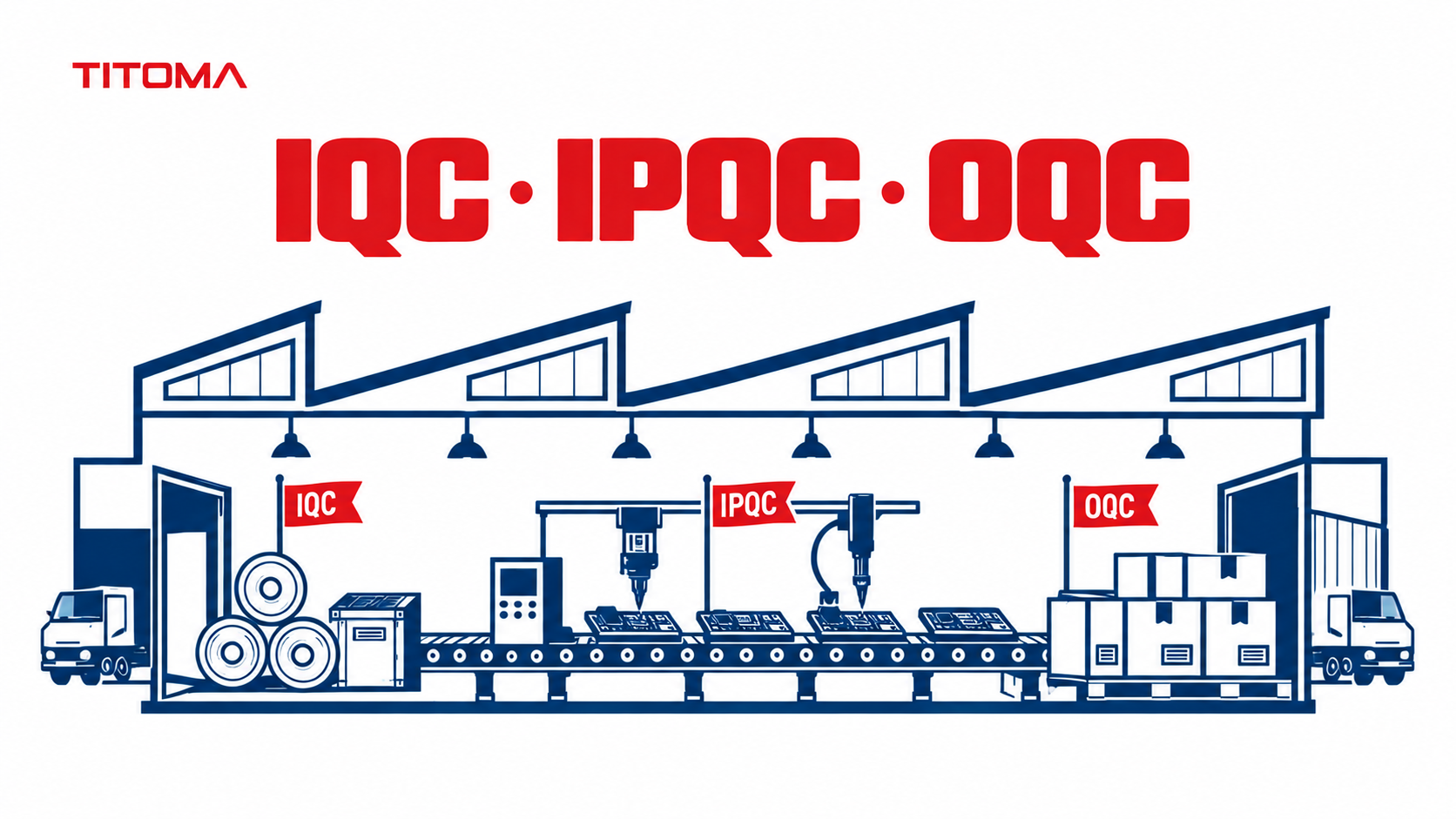
IQC (Incoming Quality Control), IPQC (In-Process Quality Control), and OQC (Outgoing Quality Control) are three checkpoints in electronics mass production. IQC checks parts before they enter the line, IPQC checks assemblies while production runs, and OQC checks finished goods before shipment. Together, they show where a defect entered and whether it was contained.
| Factor | IQC | IPQC | OQC |
|---|---|---|---|
| When | Parts arrive at the factory | During assembly | Before shipment |
| What is checked | Components, bare PCBs, plastics, and supplier documents | Process settings, first articles, and in-line test results | Finished units, packaging, and labels |
| Typical methods | Sampling inspection, part verification, and datasheet or compliance document checks | First-article inspection, patrol checks, and in-line tests | Sampling inspection, functional checks, and packaging or label checks |
| Cost of a defect found here | Usually lowest, before value is added | Medium, after some labor and materials are used | Usually highest, after assembly, testing, and packing |
IQC vs IPQC vs OQC at a Glance
The checkpoint moves with the product: receiving, assembly, then shipment. Each later discovery has more labor and material behind it, so the same defect usually costs more to contain.
What Do IQC, IPQC, and OQC Stand For?
IQC stands for Incoming Quality Control. It covers materials and purchased parts received from suppliers. IPQC stands for In-Process Quality Control. It watches the build while operators and machines are making the product. OQC stands for Outgoing Quality Control. It checks a completed lot before the factory releases it for shipment.
The acronyms on a flowchart prove little without specifications, sample sizes, stop rules, and records. Ask what fails a lot and who can hold it.
The plan must distinguish 100% checks from sample checks. Sampling does not turn an untested unit into a tested one.
What Happens at IQC?
IQC starts when purchased material arrives. Inspectors match the shipment against the approved bill of materials, purchase order, drawings, and supplier paperwork. For electronic components, the checks may include manufacturer part number, markings, package, quantity, date or lot code, moisture-sensitive handling, and storage condition. Bare PCBs and mechanical parts need their own drawing and revision checks.
Supplier documents matter as much as the carton label. A declaration for RoHS, a certificate of conformity, or a material report must identify the relevant supplier, part, and revision. A generic PDF covering an unrelated family of parts is weak evidence. IQC should flag a missing or mismatched document before the parts are issued to production.
IQC needs a risk-based receiving plan. New suppliers, changed parts, and materials with a defect history deserve tighter checks. Reduced inspection for a trusted supplier should be documented and reversible.
When a lot fails, the factory should segregate it, record the affected quantity and defect, and document whether it was returned, sorted, reworked, or approved through a concession. Rejected stock should not enter production to keep the line moving.
A bad connector lot rejected here may cost a receiving inspection and a replacement order. If it reaches assembled products, the same issue can require disassembly, retest, repacking, and a delayed shipment. That is why IQC is a material control, not a ceremonial gate at the warehouse door.
What Happens at IPQC?
IPQC begins when approved materials enter the production process. It checks that the line is building the approved revision under the intended settings. Depending on the product, the plan may cover solder paste printing, placement, reflow profile, solder joints, torque, adhesives, programming, calibration, assembly sequence, and operator instructions.
At the start of a run, a factory may inspect the first assembly or a small first batch against drawings, the approved sample, and test instructions before releasing the rest of the lot. The American Society for Quality describes first-article inspection as a documented check of an initial item or batch from a production run against the specified requirements. The factory’s actual first-article scope should be agreed for the product; an aerospace form is not automatically required for an ordinary electronics build.
Patrol inspections and process data can catch a clogged stencil, wrong reel, drifting temperature profile, or worn fixture. In-line tests such as AOI and ICT may also run here. Tie their results to serial numbers or lots to isolate the affected production window.
For assembly workmanship, IPC-A-610 provides acceptance criteria for completed electronic assemblies. Its three product classes are Class 1 for general electronic products, Class 2 for dedicated service products, and Class 3 for high-performance products, as set out in IPC’s published classification text. The buyer and manufacturer should document the applicable class and revision. IPC-A-610 does not by itself decide how often the factory patrols the line or how many units OQC samples.
If IPQC finds a defect, locate the last good check, contain units built since then, correct the cause, and verify the fix. “Reworked” alone does not prove later boards are safe.
What Happens at OQC?
OQC takes place after assembly and production tests, when the lot is ready for shipment. Inspectors compare finished units with the approved product specification and packing instructions. They may check appearance, accessories, serial labels, firmware identification, functional results, carton contents, and shipping marks. The exact list depends on what a customer could receive incorrectly even when the circuit works.
OQC commonly inspects a sample rather than every unit. The sampling plan should state lot size, inspection level, defect categories, acceptance and rejection numbers, and the agreed AQL. The ASQ quality glossary defines acceptance sampling as checking a sample to decide whether to accept a lot; its AQL definition describes a process average used for sampling inspection. An AQL is not permission to ship known defective units.
Programmed identity, safety-critical functions, or required end-of-line tests may need a 100% check. Buyer and factory must agree which tests run on every unit and which attributes OQC samples.
A failed OQC lot needs a disposition before shipment. The factory may hold the lot, sort all units, repair affected units, and repeat the required tests. The release report should show the original failure, scope of containment, corrective action, and results of reinspection. A second “pass” sheet without the first failed result hides the actual risk.
OQC is often the most expensive discovery point. Components, assembly, programming, testing, and packaging are already paid for. A wrong connector on thousands of finished products is costly to replace.
How Do IQC, IPQC, and OQC Fit After EVT, DVT, and PVT?
EVT, DVT, and PVT are development and validation stages used to prove that a product works, meets its requirements, and can be built repeatably. IQC, IPQC, and OQC are production controls that continue across manufacturing lots after release. They do not replace the engineering tests from development.
PVT should leave an approved build package with drawings, bill of materials, firmware, work instructions, test limits, and a control plan. Production QC checks each lot against that package.
A late design change may require renewed validation and updated QC instructions. If it affects a component, receiving needs the approved new part number before delivery. Plan these checks during design for manufacturing, while changes can still be made without scrapping finished goods.
What Should You Ask Your Manufacturer About Their QC Plan?
Ask for a control plan tied to your product revision. It should name each checkpoint, method, frequency, acceptance limit, record, and person authorized to release or hold material. Request a completed example from a recent lot.
- Which stage data will we receive? Request incoming lot records, first-article approval, process trends and test yields, and the final OQC release report. Agree on the reporting format before the first production order.
- What happens to a rejected lot? Ask how material is quarantined, how affected work in progress is traced, who approves sorting or concessions, and when the buyer is notified.
- Who sets the OQC sampling plan? Confirm the inspection level, defect categories, AQL values, and any 100% checks. Do not leave these to an undocumented factory default.
- How are component substitutions controlled? Require engineering approval before purchasing a substitute, then have IQC check the approved manufacturer, part number, revision, and supporting documents when it arrives.
- What triggers another first-article check? Discuss new revisions, tooling changes, line transfers, long production gaps, and process changes before they happen.
Titoma’s role as a design and manufacturing partner is to carry the approved product requirements into the factory’s purchasing, build, test, and release records. For a buyer, the useful proof is traceability: which parts entered the lot, what happened on the line, and why the finished units were cleared to ship.
