Your prototype works. Good. That still does not mean it is ready for mass production.
This is where many hardware startups get stuck. The demo works, early feedback looks fine, then the factory starts asking harder questions about design for manufacturing, sourcing, testing, and cost. Suddenly the product that felt close to launch is not close at all.
A prototype proves the idea. Mass production proves the product can be built again and again without chaos.
1. Your Design Is Stable
If your PCB, enclosure, firmware, or key features are still changing every week, you are not ready yet.
Mass production needs a stable design base. Once sourcing, tooling, and test planning start, constant design changes become expensive fast. That is why serious teams go through structured steps like EVT, DVT, and PVT testing before full production.
A simple check helps here. If a manufacturer reviews your files today, will those same files still be mostly valid two weeks from now? If not, keep refining.
2. Your BOM Is Ready for Production Sourcing
A prototype BOM is often built for speed, not scale.
Engineers pick parts that are easy to buy in low volume, available right now, or simply good enough for testing. That works for samples. It often fails in production.
A production ready BOM should support volume purchasing, reasonable lead times, second source options, and acceptable pricing. If your key parts are fragile from a supply point of view, the product is not ready for scale no matter how nicely the prototype performs.
3. You Know Your Target Unit Cost
A lot of founders know the price they want to sell at. Fewer know what the product must cost to build.
That is a problem.
Before moving toward mass production, you should have a realistic target unit cost. Not fantasy. Not investor math. A real number shaped by assembly, testing, packaging, freight, scrap, and margin.
If you do not know that number yet, production decisions become guesswork. And guesswork gets expensive.
4. You Have a Realistic Volume Forecast
Factories do not care about forecasts because they enjoy spreadsheets. They care because volume affects everything.
Pricing, tooling, supplier attention, material planning, and line setup all depend on expected demand. If your forecast is basically “we’ll see after launch,” that is not enough to make a strong manufacturing case.
You do not need huge numbers. You do need a credible plan for first orders and what comes after.
Projects with no clear path to repeat business usually get lower priority. That is not unfair. It is just factory logic.
5. Your Product Can Be Assembled Efficiently
Some prototypes work only because one engineer knows all the little tricks needed to make them behave.
That is not scalable.
A mass production ready product should be designed so assembly is practical, repeatable, and not dependent on manual rescue work. If cables are hard to route, tolerances are too tight, or parts need hand fitting, those problems grow very quickly on the line.
This is exactly why mass production planning should start before you commit to tooling or launch dates.
6. You Have a Clear Test Plan
If your current test method is turning the device on and seeing whether it seems fine, you are still in prototype mode.
Mass production needs repeatable testing. Every unit should have a defined way to be checked, with clear pass and fail criteria. Even in regulated industries, the principle is the same. The FDA design controls guidance and the electronic Code of Federal Regulations both stress design validation on production units or their equivalent under defined conditions.
Your product may not be medical. The lesson still applies. Validation needs to reflect real production reality, not bench top optimism.
7. You Are Ready to Make Business Decisions
Mass production is not just an engineering step. It is a business commitment.
At some point, you are no longer experimenting with a concept. You are locking parts of the design, committing budget, planning quality control, and preparing for real supply chain consequences.
If the project still feels like something you can change endlessly without tradeoffs, it is probably not ready for mass production yet.
That is not failure. It just means the product is earlier than it looks.
Where Startups Usually Get Stuck
Most teams do not fail because of one dramatic mistake.
They get blocked by a pile of smaller ones. The design is mostly done, but still unstable. The BOM works for samples, but not for sourcing. The target cost is vague. The forecast is weak. Testing is still informal.
None of that looks fatal on its own. Together, it is exactly what slows a product down when the factory takes a serious look.
From the founder’s side, the product feels nearly finished. From the factory’s side, the hard part is only starting.
A Simple Readiness Check
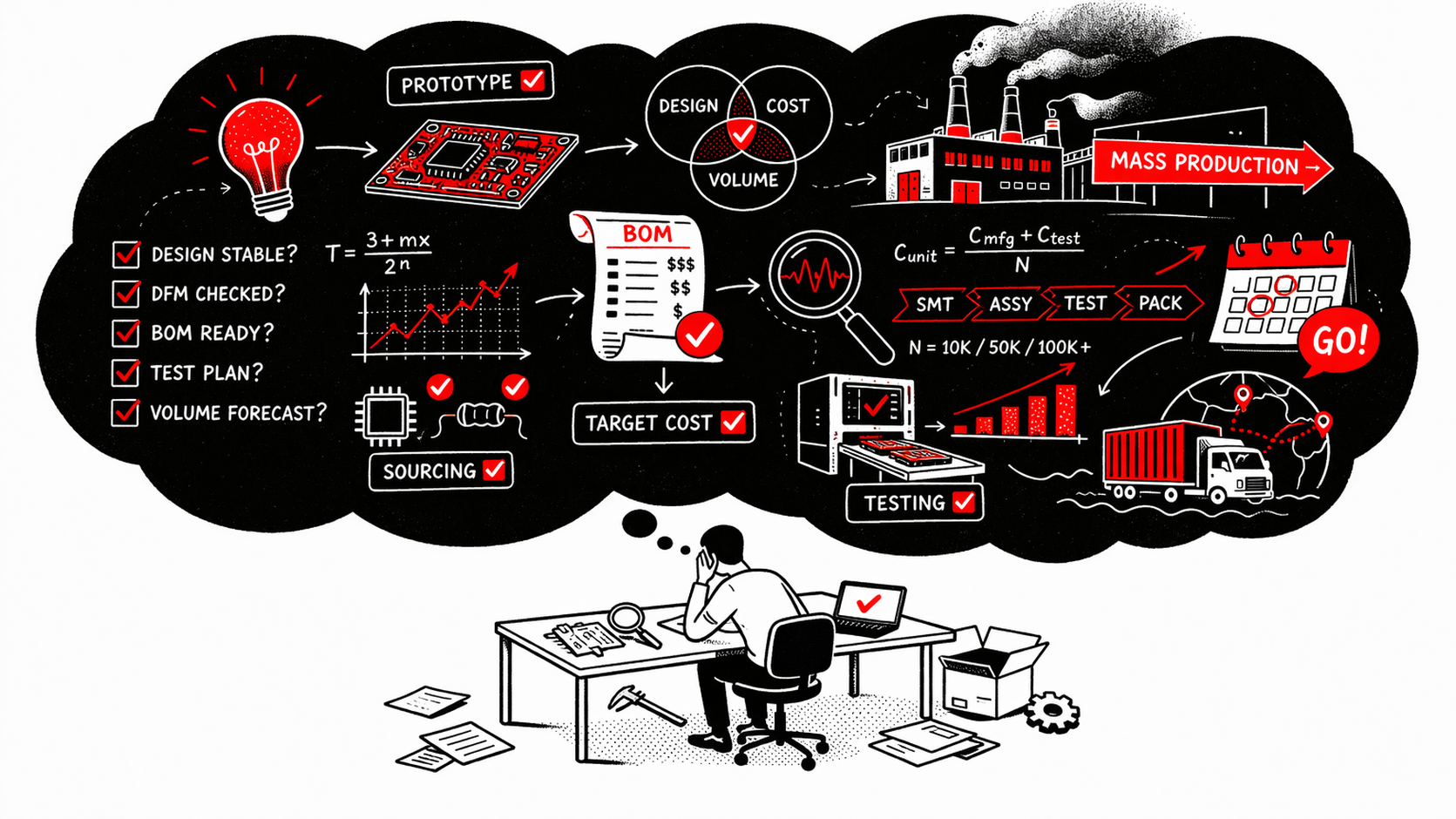
You are probably ready to move toward mass production if:
- Your design is stable
- Your BOM supports real sourcing
- You know your target unit cost
- You have a realistic first production volume
- Your product can be assembled efficiently
- You have a clear test plan
- You are ready to make business commitments
If several of those are still missing, slow down and fix them first.
That is much cheaper than discovering the gaps after tooling, purchasing, and scheduling have already started.
What to Do Next
If your prototype is not ready yet, do not force it forward.
Review the design for manufacturability. Clean up the BOM. Clarify the cost target. Define the test process. Be honest about your production forecast.
If your prototype is ready, then the next step is not more guessing. It is a proper DFM review and a structured move toward manufacturing.
Book a DFM Consultation
If you are past the prototype stage and thinking seriously about scale, this is the right point to get a manufacturing review.
A DFM consultation helps spot sourcing risks, assembly issues, test gaps, and design choices that may become expensive later. Much cheaper than finding out too late that the prototype was never production ready.