
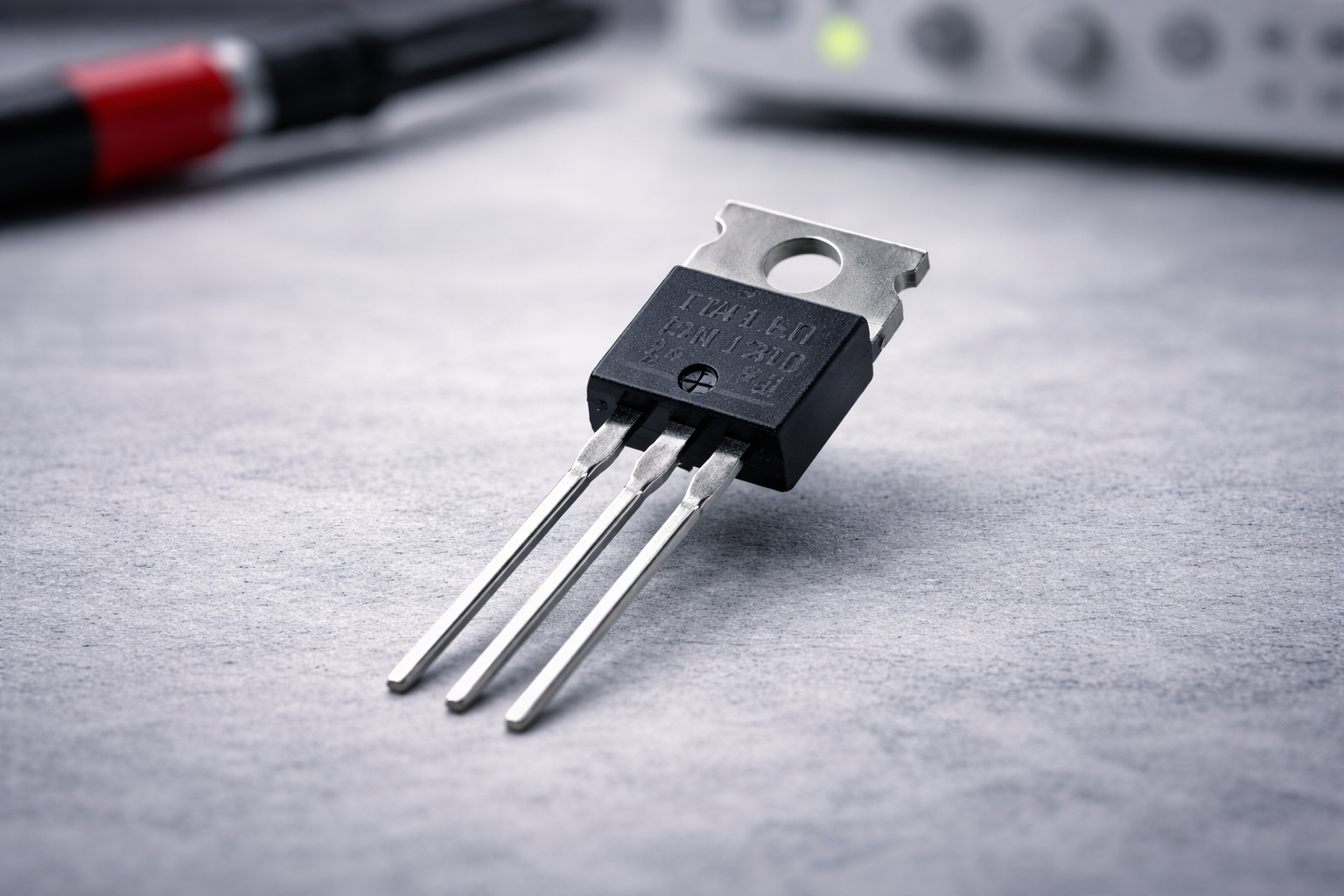
The transistor is one of the smallest parts in modern electronics, and one of the most important.
Without it, there is no practical computing, no compact power control, no signal amplification, and no cheap mass market electronics. Phones, laptops, motor drives, sensors, audio gear, and power supplies all depend on transistors doing quiet work in the background.
At a basic level, a transistor is a semiconductor device used to control electrical signals. It can act as a switch, turning current on and off, or as an amplifier, making a weak signal stronger. That sounds simple, but this tiny function is what makes complex electronics possible.
What a transistor actually does
A transistor controls a larger electrical effect using a smaller input.
That is the whole trick.
In one circuit, it may switch an LED or relay. In another, it may amplify a microphone signal. In a power design, it may regulate energy flow inside a converter or battery system. In digital electronics, billions of transistors switch constantly to process logic states.
So while the word sounds technical, the role is straightforward. A transistor is a control device. It lets one signal influence another in a predictable way.
When people first learn about transistors, it helps to place them in the wider PCB context. Titoma makes that point well in its article on commonly used PCB components, where the real issue is not just what a part does in theory, but how that choice affects sourcing, EMI, yield, and reliability once the design leaves the bench and heads toward production. That is exactly where transistor selection stops being classroom material and starts becoming a product decision.
The two main transistor families
Most transistor discussions quickly split into two broad groups.
The first is the Bipolar Junction Transistor, usually shortened to BJT.
The second is the Field Effect Transistor, usually shortened to FET.
They do similar jobs, but they do not work in the same way.
Bipolar Junction Transistor or BJT
A BJT is a current controlled device.
It has three terminals called the emitter, base, and collector. A small current at the base controls a larger current flowing from collector to emitter.
The two common BJT structures are NPN and PNP.
In practical terms, a BJT is useful when you want reliable switching or amplification and can tolerate some drive current at the control side. It has been used for decades in analog circuits, signal stages, and many low cost control applications.
Field Effect Transistor or FET
A FET is a voltage controlled device.
Its three terminals are gate, source, and drain. Instead of using base current like a BJT, it uses an electric field at the gate to control current flow between source and drain.
That is a big reason FETs are so popular. They usually need less input power at the control side.
The main FET types are JFET and MOSFET, with MOSFETs being the most common in modern electronics. They show up everywhere from logic circuits and battery systems to motor control and power conversion.
BJT vs FET
The difference is easy to summarize.
A BJT is controlled by current.
A FET is controlled by voltage.
That sounds like a small distinction, but it affects efficiency, switching behavior, drive design, and where each device fits best.
In broad terms, BJTs are often used where analog behavior and gain matter, while FETs are widely used where low power control and fast switching are important. Real designs are more nuanced than that, of course, but it is a useful starting point.
The same logic applies at the system level. In its article on core embedded components for DFM, Titoma looks at building blocks through the lens of manufacturability and supply chain stability. A transistor is not just a symbol in a schematic. It also affects thermal behavior, drive requirements, board layout, and how comfortably the design can survive mass production.
Transistor as a switch
One of the most common transistor jobs is switching.
In the off state, current does not flow through the controlled path. In the on state, current flows.
That simple action is behind a huge amount of electronics.
A transistor can switch LEDs, control relays, drive motors, enable power rails, or process digital logic. In microcontrollers and processors, switching is happening constantly at high speed. In power electronics, switching has to be fast, efficient, and controlled carefully to avoid heat and losses.
This is where the transistor stops being abstract and starts becoming useful. It turns control logic into real electrical action.
For the power side, ON Semiconductor’s MOSFET Basic is useful because it shows why power MOSFETs became so dominant in switching applications. Compared with bipolar power transistors, MOSFETs are widely used where efficiency and switching behavior matter more, especially in modern power electronics.
Transistor as an amplifier
The other major role is amplification.
Here, a small input signal controls a larger output signal. That makes the transistor essential in audio circuits, sensor interfaces, radio stages, and many analog systems.
A weak microphone signal, for example, is not useful on its own. A transistor stage can amplify it enough for further processing. The same idea applies to radios, measurement circuits, and countless signal conditioning designs.
Amplification sounds less glamorous than computing, but it remains fundamental. Electronics still has to deal with real world signals, and those signals are often weak, noisy, or both.
Where transistors are used
Almost everywhere.
- Computers and processors
- Mobile phones
- Audio amplifiers
- Power supplies
- Motor drivers
- Switching circuits
- TVs and radios
- Sensors and control boards
- Battery management systems
In modern systems, transistors are not optional building blocks. They are the core mechanism that makes electronic control practical.
Why transistors became so dominant
They solved several problems at once.
- They are small.
- They are fast.
- They are relatively cheap.
- They can switch efficiently.
- They can be integrated into very dense circuits.
This is why electronics moved so far beyond older vacuum tube technology. Transistors made circuits more compact, more reliable, and easier to scale into mass production.
That said, the story is not pure upside. Transistors also bring tradeoffs. They can be sensitive to heat, damaged by overvoltage, and difficult to manage properly in large or fast switching designs. Once frequencies rise or power levels climb, layout, thermal design, and protection circuits start to matter a lot more.
Infineon makes a similar point in its Power MOSFET Basics material, where MOSFETs are tied directly to voltage and current handling, device geometry, and switching use cases. Once transistor discussion moves from school examples into real hardware, device structure, losses, and operating conditions matter a lot more than the simple switch or amplifier definition suggests.
Why this still matters in product design
It is easy to treat transistors as solved, boring parts. That is a mistake.
The choice between a BJT and a MOSFET, the switching speed, the gate drive, the thermal margin, and the safe operating limits can all affect product cost, efficiency, reliability, and manufacturability. In low volume prototypes, some of these problems stay hidden. In production, they tend to show up more clearly.
A transistor may be tiny, but bad decisions around it can create heat problems, EMC issues, unstable control behavior, or early field failures.
That is also why transistor choice belongs in broader DFM thinking. Titoma’s piece on questions to answer before starting DFM argues that key component decisions should be reviewed early, before they quietly become cost, sourcing, or reliability problems later. With transistors, that often means thinking ahead about package type, switching losses, thermal path, and whether the surrounding layout will still behave properly at scale.
Texas Instruments adds a practical angle in Introduction to Power MOSFETs and Their Applications. TI explicitly notes that customers still need to provide proper safeguards in real applications, which is a polite way of saying transistor choice alone does not guarantee a good design. Drive circuit design, protection, layout, and thermal control still decide whether the product behaves well in the field.
Final thought
A transistor is a semiconductor device that controls, switches, or amplifies electrical signals.
That is the simple definition.
The more useful definition is this. It is the part that lets electronics do work instead of just sit there.
BJTs and FETs do that in different ways, but both are foundational to modern circuit design. Whether the job is switching power, amplifying audio, or processing digital logic, the transistor remains one of the most important building blocks in electronics.
Tiny part. Huge consequences.