


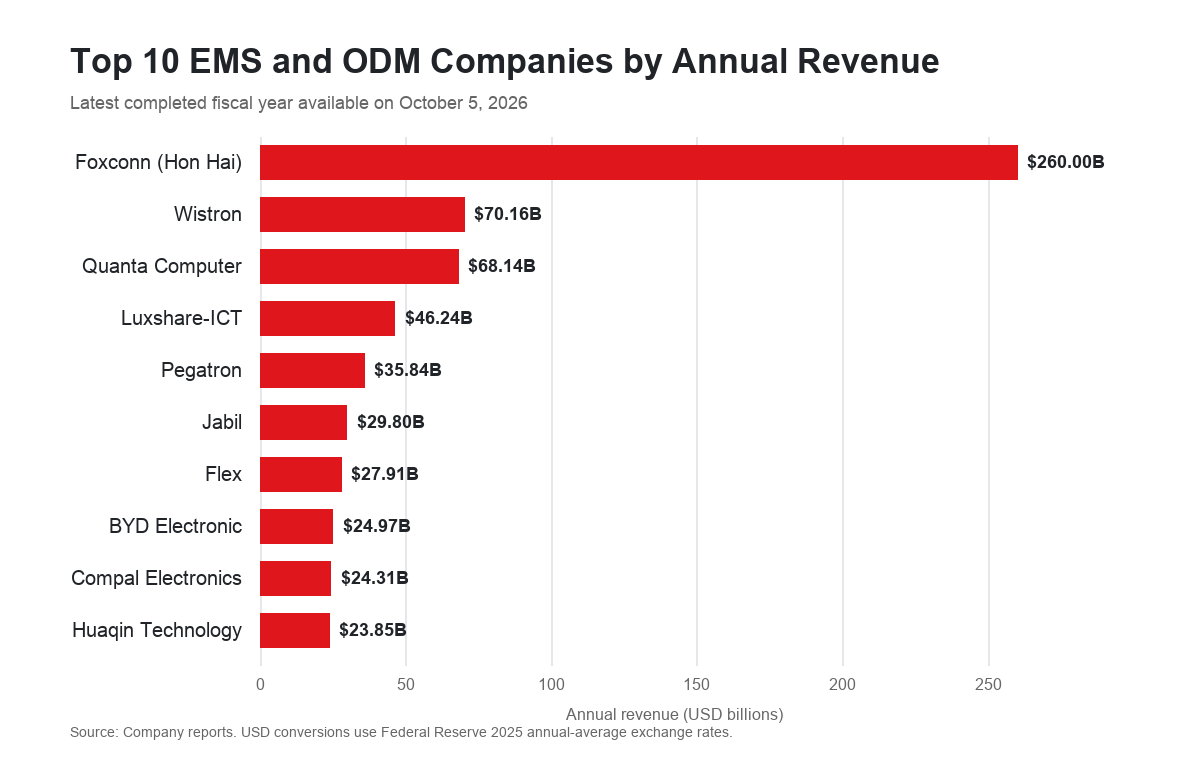
Foxconn is the world’s largest EMS and ODM company by total annual revenue, generating approximately $260 billion in FY2025. It is followed by Wistron at $70.16 billion and Quanta Computer at $68.14 billion.
What is an EMS company?
An electronics manufacturing services (EMS) company builds electronic products for other brands. Depending on the contract, an EMS provider may handle component sourcing, PCB assembly, box build, testing, logistics, and after-sales support. An original design manufacturer (ODM) may also contribute product design.
This ranking uses total consolidated company revenue for the latest completed fiscal year publicly available on October 5, 2026. It covers major EMS and ODM companies whose primary business is manufacturing or designing electronics for other brands. Revenue shows scale, but buyers should also compare engineering support, product complexity, testing, certifications, and change control.
Top 10 EMS companies ranked by annual revenue
| Rank | Company | HQ | Revenue | Fiscal year | Main segments |
|---|---|---|---|---|---|
| 1 | Foxconn (Hon Hai) | Taiwan | $260.00B | FY2025 | Consumer electronics, cloud and networking, computing, components |
| 2 | Wistron | Taiwan | $70.16B | FY2025 | AI and general servers, notebooks, enterprise products |
| 3 | Quanta Computer | Taiwan | $68.14B | FY2025 | Cloud servers, notebooks, smart devices |
| 4 | Luxshare-ICT | China | $46.24B | FY2025 | Consumer electronics, data centers, automotive, components |
| 5 | Pegatron | Taiwan | $35.84B | FY2025 | Communications, computing, consumer electronics |
| 6 | Jabil | United States | $29.80B | FY2025 | Intelligent infrastructure, connected products, automotive, healthcare |
| 7 | Flex | United States | $27.91B | FY2026 | Data centers, automotive, industrial, healthcare, power |
| 8 | BYD Electronic | China | $24.97B | FY2025 | Mobile devices, intelligent products, automotive systems, AI servers |
| 9 | Compal Electronics | Taiwan | $24.31B | FY2025 | PCs, smart devices, servers, automotive and medical electronics |
| 10 | Huaqin Technology | China | $23.85B | FY2025 | Mobile terminals, computing, data centers, AIoT |
Revenue method: The table uses total consolidated company revenue, not EMS-only revenue. TWD results were converted at the Federal Reserve’s 2025 annual-average rate of NT$31.1663 per US dollar, and CNY results at RMB7.1875 per US dollar. For Jabil, the ranking uses its audited FY2025 Form 10-K rather than preliminary FY2026 results. The table rounds all USD values to two decimal places.
What does the ranking show?
Foxconn operates at a different scale
Foxconn’s revenue was about 3.7 times Wistron’s and exceeded the combined revenue of companies ranked second through fifth. That capacity can support very large programs, but it does not automatically make Foxconn suitable for a specialized industrial controller, medical device, or lower-volume product.
Taiwan remains central to electronics manufacturing
Five of the top ten companies are headquartered in Taiwan. China contributes three more, so eight of the ten are based in Asia. Buyers should still verify where their specific product will be built, since headquarters location does not show the factory country, tariff exposure, approved vendor list, or backup-production plan.
AI servers are changing the order
Wistron’s 2025 revenue increased 108%, while Quanta grew about 50.5%, and Huaqin grew 56%. AI infrastructure can also compete for high-end PCB capacity, power components, connectors, cooling hardware, memory, and skilled production resources.
How should you compare EMS companies for a real product?
- Engineering: Who reviews the schematic, PCB layout, enclosure, tolerances, and design for test?
- Volume fit: Does your forecast and product lifetime fit the factory’s business model?
- BOM control: How are lifecycle risks, approved alternates, and substitutions managed?
- Testing: Who develops programming, functional, RF, calibration, and test-data systems?
- Compliance: Who owns samples, technical files, laboratory coordination, and corrective actions?
- Change control: How are PCNs, firmware versions, fixture changes, and deviations approved?
- Factory transfer: Who owns the source files, test software, tooling, and work instructions?
Titoma’s overview of electronics manufacturing services explains how design, sourcing, testing, and production responsibilities can be divided between a product company and its manufacturing partner.
Practical takeaway
Use revenue as the first filter, not the final decision. Select a partner whose factory economics match your volume, whose engineers understand your product’s likely failure modes, and whose sourcing, test, compliance, and change-control processes can be verified before production starts.
FAQs
Should a startup choose a large EMS company?
What files should be ready before requesting an EMS quotation?
Who is responsible for product certification when using an EMS supplier?
How should component substitutions be controlled during production?
What should a factory handover package contain?
Sources
- Hon Hai FY2025 results
- Wistron FY2025 results
- Quanta 2025 monthly sales
- Luxshare-ICT 2025 annual report
- Jabil FY2025 Form 10-K
- Pegatron 2025 sales report
- Flex FY2026 results
- BYD Electronic 2025 annual report
- Compal FY2025 results
- Huaqin 2025 sustainability report
- Federal Reserve 2025 annual-average exchange rates
