
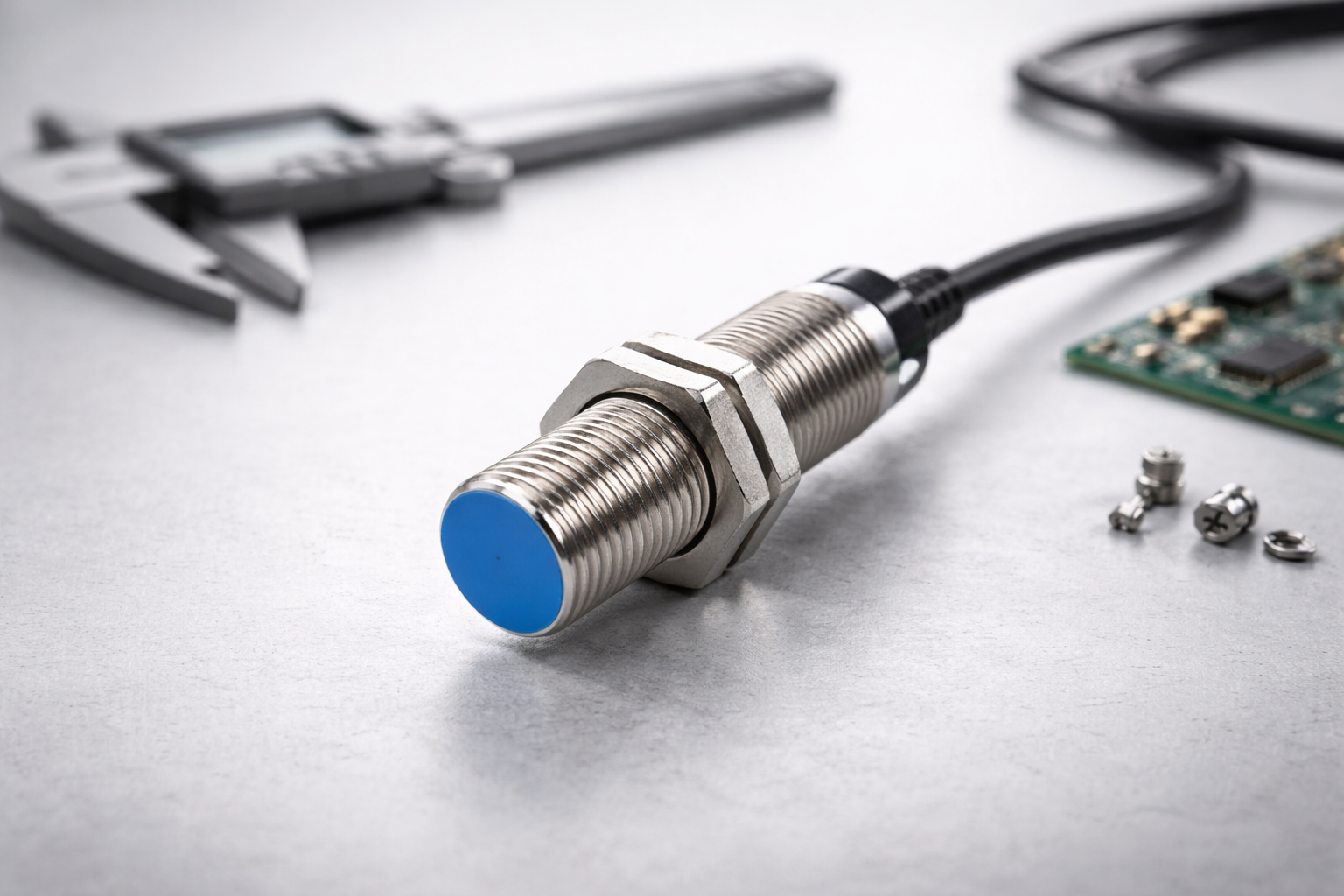
Proximity sensors look easy on paper. Detect something without touching it. Ship the product. Move on.
In real projects, that is where the trouble starts.
The wrong sensor can trigger too early, miss the target, fail after an enclosure change, or behave differently once the product leaves the lab and lands in a factory, warehouse, hospital, or humid kitchen. That is why sensor choice should not be treated like a late BOM decision. It needs to be part of the product architecture early.
What a proximity sensor actually does
At the simplest level, a proximity sensor detects the presence or movement of a nearby object without physical contact. That sounds broad because it is. “Proximity sensor” is not one technology. It is a category, and each option fails in its own special way.
For product teams, the real question is not “Do we need a proximity sensor?” It is “What exactly are we trying to detect, at what distance, in what environment, with what tolerance for error?”
That second question is the one that saves redesign time.
Before you compare specific parts, it helps to step back and look at the broader sensor landscape. If you have not done that yet, our guide to the 6 essential sensors every engineer must know is a useful starting point because it shows where proximity sensors sit alongside PIR, ultrasonic, ambient light, and gas sensing in real product development.
Start with the target, not the sensor
Many teams start by picking a familiar sensor type. That is backwards. Start with the target object and the use case.
If you need to detect metal
Inductive sensors are usually the cleanest choice for metallic targets. They are widely used because they offer non contact detection and hold up well in harsh industrial conditions.
This makes them a strong fit for things like dock detection, machine position sensing, latch confirmation, and metal part presence in fixtures.
If you need to detect plastic, liquid, glass, or mixed materials
Capacitive sensors are often more useful. They can detect non metal objects such as liquids and plastics. That opens the door for tank level sensing, cartridge detection, packaging presence, and sealed consumer devices where you want hidden sensing behind a surface.
The catch is sensitivity. Capacitive sensing is more easily affected by surrounding materials, moisture, and installation details. Good for flexibility. Bad for sloppy integration.
If distance is longer or the object varies a lot
Ultrasonic or photoelectric options may be better. This is where many teams waste time. They use an inductive sensor because it is common, then realize later they are trying to detect cardboard, fingers, water, or clear plastic. Physics is rude like that.
The five things that matter before you lock the part
A proximity sensor should be selected as part of the system, not in isolation.
Detection distance
Datasheets love ideal numbers. Real products do not live in ideal conditions.
Detection distance changes with target material, target size, mechanical tolerances, and mounting conditions. If your design margin is tiny, your field failure rate may not be.
Give yourself margin. If you need 5 mm, do not build a product that only works at 5.1 mm on a clean bench.
Environment
Heat, water, chemicals, dust, and cleaning cycles all matter. That does not mean every sensor can survive your environment. It means you need to match the sensor family to the actual use case. Consumer electronics, industrial tools, kitchen devices, and medical hardware do not punish parts in the same way.
Mounting and enclosure effects
This is where nice prototypes go to die.
If your industrial design team changes wall thickness, adds a bracket, swaps a stainless plate, or tightens internal packaging late in development, your sensor behavior may shift with it.
This is also where classic design for manufacturing discipline matters. A proximity sensor that works on the bench can still become a bad production choice if mounting clearances, factory capabilities, or component availability were ignored too early in the architecture phase.
This is also why DFM and enclosure design should not sit in separate silos.
Output and interface
Output type matters too. A sensor that detects correctly but complicates wiring, controller integration, or diagnostics can still create unnecessary cost and delay.
A sensor that works electrically but complicates harnessing, firmware logic, or test fixtures is not a good sensor choice. It is just a hidden cost.
For teams that want a deeper technical reference on sensing methods, Omron’s Technical Guide to Proximity Sensors is worth reviewing. It lays out the main non contact detection methods and highlights installation issues such as surrounding metal, target conditions, and interference between nearby sensors.
Supply chain risk
A sensor may fit technically and still be the wrong choice commercially.
You need to check second sources, regional availability, lifecycle status, and lead time risk before you get attached to a part number. This is especially true for products heading toward scale. A clever design built around a niche sensor can turn into a procurement headache fast.
That problem usually shows up late, after somebody has already fallen in love with the prototype.
If you are building a more connected or programmable device, the sensor decision should not be isolated from the rest of the embedded system. Our article on embedded systems in 2026 and core components for DFM explains why sensors and actuators should be treated as sourcing and production risks, not just functional blocks on a diagram.
Common failure modes teams miss
Sensor failure is not only about dead parts. It is often about unstable behavior.
False triggering, missed detection, drift, and intermittent performance are more common than dramatic total failure. Small environmental shifts can affect what the sensor thinks it sees.
That sounds obvious. It also describes a surprising number of field failures.
Typical trouble spots
Products get into trouble when teams ignore target variation, moisture, wiring noise, mechanical stack up, sensor to sensor spacing, or enclosure materials. Capacitive sensing is especially easy to disrupt if you tune it tightly and then change plastics, adhesives, or wall thickness late in the project. Inductive sensing is more forgiving with metal targets, but even there, mounting geometry and surrounding metal still matter.
This is why validation should include ugly real world cases, not only happy path tests.
Test the system, not just the sensor
A bench test proves almost nothing by itself.
You want to test across tolerance extremes, production materials, temperature swings, contamination, low voltage conditions, and assembly variation. If the sensor only works when one engineer is holding the prototype at exactly the right angle, you do not have a product yet. You have a demo.
How to choose the right type for mass production
For mass production, a good sensor choice is usually the one that gives you enough performance with the least drama.
If your target is metal and the distance is short, start with inductive. If you need to detect non metal materials or liquids through a wall, evaluate capacitive. If range is longer or the target changes shape and material a lot, consider ultrasonic or photoelectric options. Then pressure test that choice against enclosure changes, tolerance stack, sourcing, contamination, and line test strategy.
That is the boring answer. It is also the one that usually survives production.
Output type matters too. A sensor that detects correctly but complicates wiring, controller integration, or diagnostics can still create unnecessary cost and delay. Rockwell Automation’s proximity sensor technical documentation is a solid reference if you want to compare practical documentation across capacitive and inductive product families.
Where Titoma fits
This is exactly the kind of decision that looks small and then causes weeks of delay if handled too late.
Sensor selection touches electronics, mechanics, firmware, sourcing, test, and manufacturing. The right way to handle it is early cross functional work, not a last minute part swap. If you are developing a new electronic product, proximity sensing should be reviewed alongside enclosure design, DFM, component sourcing, and assembly risk before the design hardens.
That saves more pain than any clever sensor ever will.
Conclusion
Choosing a proximity sensor is not about finding the most advanced part. It is about finding the one that still behaves properly after your enclosure changes, your factory scales, your product gets dirty, and your buyer asks for an alternative source.
That usually means less romance and more engineering discipline.
Boring, I know. But boring products tend to ship.