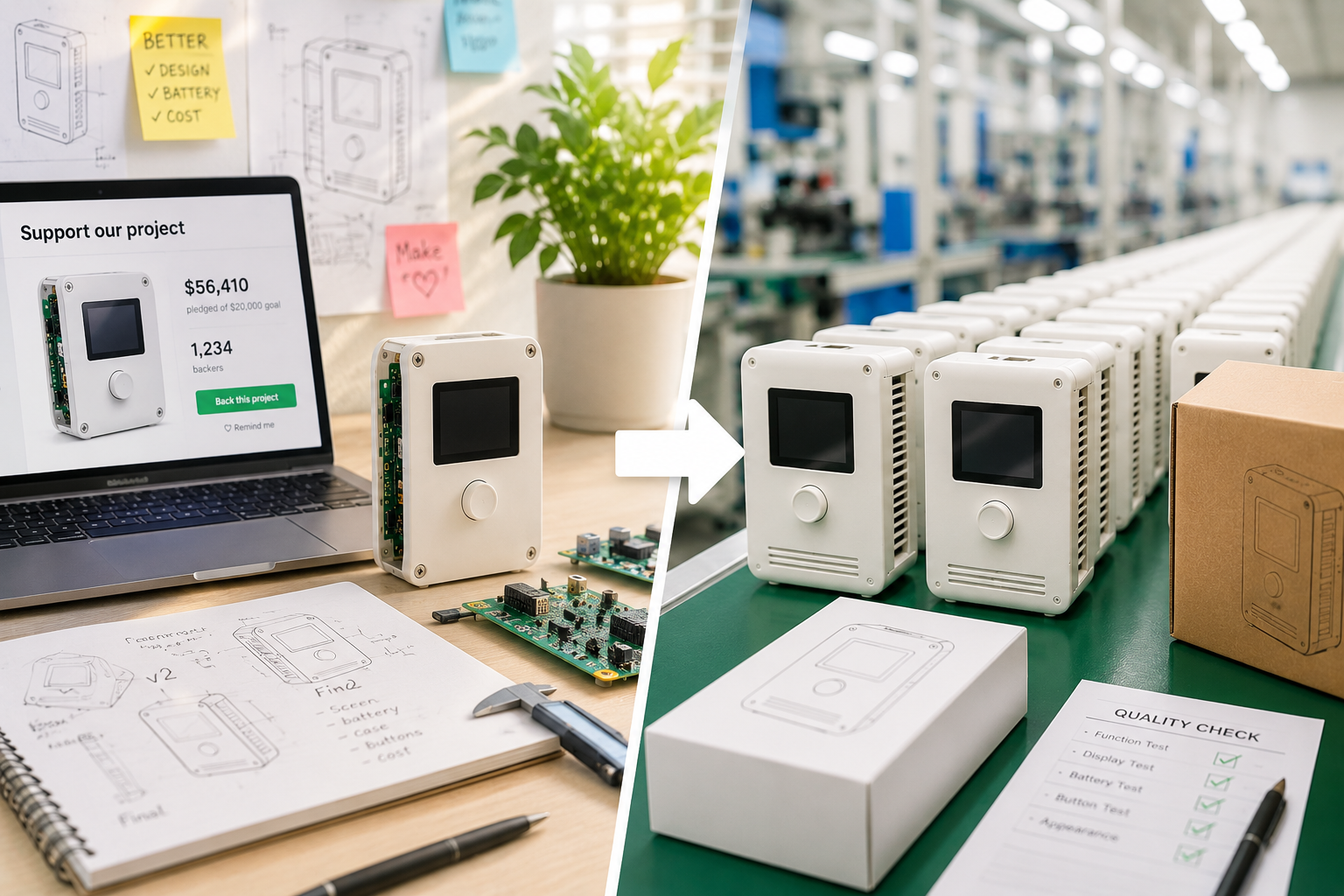
A successful Kickstarter campaign proves one thing: people may want your product.
It does not prove the product is ready for mass production.
That is the part many hardware startups underestimate. A prototype can be hand-built, adjusted, repaired, and explained away. A production unit cannot.
Once a product moves into tooling, sourcing, assembly, production testing, packaging, and shipping, small design problems become expensive. A weak screw boss becomes rework. A hard-to-reach connector becomes labor cost. A sensor that worked on the bench may fail inside the final enclosure.
Kickstarter manufacturing is not just about finding a factory. It is about proving the product can be built repeatedly, tested reliably, and shipped without turning every batch into a rescue mission.
Prototype Success Is Not Production Readiness
A prototype shows that the idea can work.
Production asks a harder question: can the same product be built 1,000 or 10,000 times with stable quality?
Many prototypes rely on the people who built them. They know which cable is fragile. They know which connector needs care. They know which firmware step is awkward. They know which enclosure clip needs “a little pressure.”
That knowledge does not scale.
In mass production, the product needs to be clear to assemble, easy to test, and hard to build incorrectly. If every unit needs special attention, the design is not ready for production. It is still a prototype with better lighting.
Common prototype-to-production problems include:
- Parts that fit once, but not consistently
- Screws that strip plastic bosses
- Cables that get pinched during assembly
- Sensors affected by enclosure material or placement
- Firmware loading that takes too long
- No useful test points on the PCB
- Cosmetic parts that warp after molding
- Products that pass bench tests but fail after shipping
This is why DFM should start before the product is frozen, not after the first production delay. Titoma’s DFM guide makes the same point: manufacturability, sourcing, assembly, and testing need to be part of the design discussion from the start.
Tooling Decisions Lock In Cost and Risk
Injection molding is often where hardware startups learn that plastic is not just “the shape around the electronics.”
A 3D printed enclosure may look fine for a prototype. Molded plastic has different rules. Wall thickness, draft angle, ribs, bosses, gates, shrinkage, ejector pins, and material choice all affect the final part. Poor molding design can lead to defects such as sink marks, warpage, short shots, and dimensional instability.
Tooling also locks in decisions.
A one-cavity mold costs less upfront but produces fewer parts per cycle. A multi-cavity mold can lower unit cost at higher volume, but it costs more and makes design changes more painful.
Changing a CAD file is cheap.
Changing a mold is not.
Before cutting tooling, founders should check:
- Is the enclosure design stable?
- Has the PCB fit been verified?
- Are connector locations final?
- Are wall thickness and ribs suitable for molding?
- Are screw bosses strong enough?
- Will the plastic part warp, sink, or show cosmetic defects?
- Does the enclosure affect antennas, sensors, heat, or sealing?
This is where DFM and DFA need to be checked together. A plastic part that molds well but takes too long to assemble is still a problem. A neat PCB layout that blocks fixture access is also a problem. Congratulations, you optimized the wrong thing.
A BOM Needs a Supply Chain, Not Just Parts
A prototype BOM is often built from whatever parts were easy to buy online.
That is fine for ten units. It is risky for production.
A production BOM needs to account for lead times, lifecycle status, MOQ, second sources, price breaks, packaging format, and supplier reliability.
The part that worked perfectly in your prototype may be a bad production choice if it has a 26-week lead time, no second source, poor availability, or a supplier that treats datasheet changes as a fun surprise.
Before mass production, review the BOM for:
- Obsolete or not-recommended-for-new-design parts
- Single-source ICs, sensors, displays, connectors, and modules
- Long lead-time components
- MOQ problems
- Price changes at real production quantities
- Battery, wireless, and certification risks
- Parts that are hard to inspect or rework
A resilient BOM is not just a purchasing document. It is part of the production design. Titoma’s BOM sourcing article focuses on reducing hidden manufacturing costs and delays through better sourcing decisions.
For prototype orders, distributors like DigiKey make it easy to check inventory and incoming stock dates, but that still does not replace a production sourcing plan. DigiKey’s own lead-time tools exist because availability changes, and production quantities need more planning than a shopping cart.
A cheap component is not cheap if it causes delays, rework, or redesign.
A good manufacturing partner should challenge the BOM early. Not because they enjoy being difficult, although sometimes it looks that way, but because sourcing risk becomes production risk fast.
Assembly and Production Testing Must Be Designed Early
Products do not become easy to build by accident.
Assembly and production testing need to be designed into the product from the start.
That means thinking about fixtures, test points, firmware loading, inspection steps, operator access, and QC limits before the design is frozen.
Founders should ask:
- Can the product be assembled without special tricks?
- Are connectors keyed or clearly marked?
- Can screws be installed quickly without damage?
- Are test points accessible?
- Can firmware be loaded on the line?
- Is there a production test mode?
- Can a fixture test the key functions?
- Are pass and fail limits clear?
- Can failed units be diagnosed without destroying the product?
Production testing does not need to be fancy. It needs to catch the failures that matter.
Titoma’s guide to PCB testing methods in real production explains why test access and test planning must be designed into the board, not improvised after the first batch.
If the PCB has no test points, the enclosure blocks access, and the firmware has no factory mode, testing becomes slow and manual. That increases cost and lets defects escape.
This is where DFM, electronics product design, and factory planning need to meet. Treating them as separate steps is how products end up “almost ready” for six expensive months.
What Founders Should Prepare Before Asking for a Manufacturing Quote
A useful quote needs useful inputs.
A manufacturer cannot give a serious production quote from a render, a pitch deck, and a hopeful launch date. They can guess. Guessing is not planning.
Before asking a manufacturing partner for a quote, prepare:
- CAD files for the enclosure and mechanical parts
- PCB files, including Gerbers and assembly files
- A complete BOM with manufacturer part numbers
- Prototype status and what has been tested
- Target production quantity
- Target unit cost
- Required certifications, such as FCC, CE, RoHS, UL, or battery transport rules
- Packaging requirements
- Production testing expectations
- Expected launch date
This overlaps with the checks in Titoma’s guide on how to approach a manufacturer for mass production, especially around prototype status, BOM maturity, cost targets, testing, and volume planning.
The more complete the input, the less fantasy goes into the quote.
That matters because many Kickstarter delays are not caused by one big failure. They come from dozens of small missing details that nobody priced, planned, or tested early enough.
Final Takeaway
Kickstarter tells you whether the market may care.
Mass production tells you whether the product can survive real manufacturing, real suppliers, real testing, real shipping, and real customers.
A working prototype is a good start. It is not production readiness.
Before moving into tooling and mass production, hardware startups should review the design for DFM, sourcing risk, assembly time, production testing, and reliability. For many products, that also means going through EVT, DVT, and PVT before full production. Titoma’s EVT, DVT, and PVT guide explains how these stages help catch design and manufacturing problems before scale.
That is the boring work.
Boring work is usually what keeps hardware companies alive.