
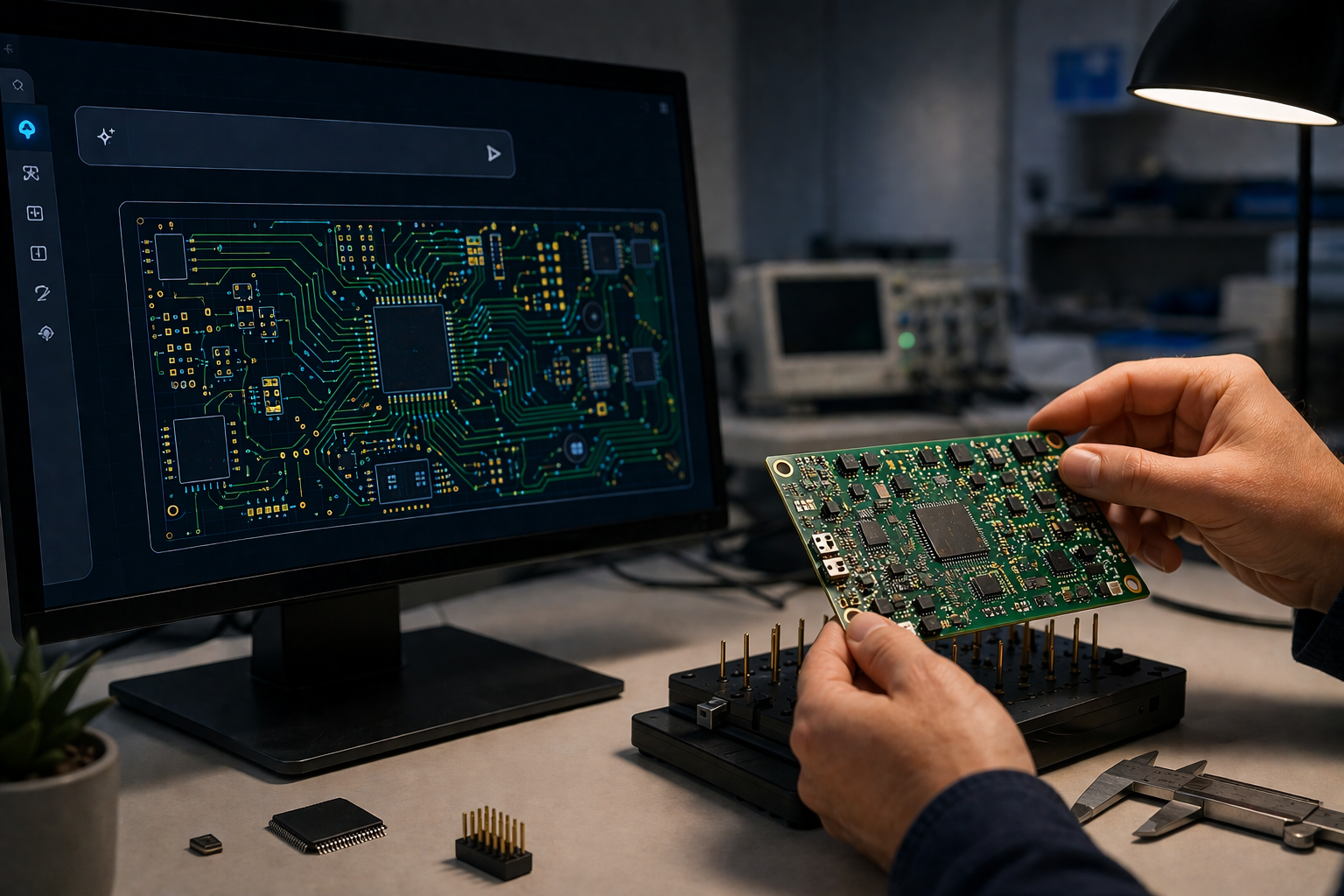
AI is moving into electronic design automation fast. Cadence, Siemens, and newer PCB automation tools are all pushing AI-assisted design, review, layout, verification, and manufacturing workflows.
That is useful. Nobody should miss hand-checking the same clearance rule for the 400th time.
But hardware is not software. A PCB can pass a rule check and still fail in assembly, testing, enclosure fit, sourcing, or field reliability. The design file may look clean. The production floor may still hate it.
This is where the current hype around AI in electronic design automation 2026 needs a little adult supervision.
What Does “Vibe Coding for Hardware” Mean?
In software, vibe coding usually means using AI prompts to generate code quickly, then testing and editing the result. In hardware, the same idea is starting to show up in schematic drafting, PCB layout exploration, component selection, rule checking, and documentation.
Instead of manually setting up every design step, an engineer may ask an AI tool to suggest a circuit block, compare components, generate constraints, review a schematic, or help prepare layout options.
That is not fantasy anymore. Cadence describes AI use across IC and SoC design, verification, PCB design, and multiphysics analysis. Siemens also announced Fuse EDA AI Agent for semiconductor, 3D IC, PCB, design verification, and manufacturing sign-off workflows.
So yes, prompt engineering for hardware is becoming part of the conversation. But do not confuse “part of the workflow” with “the engineer can now go play golf.” Hardware still has a way of punishing optimism.
Where AI Helps in PCB Design
AI can help with the boring parts of electronic design. That is not an insult. Boring work is where many mistakes hide.
AI-assisted tools can help engineers draft early schematics, compare component options, suggest layout constraints, review documentation, and catch repeatable design rule issues. For some teams, this can shorten early design cycles and reduce the amount of manual checking needed before deeper engineering review.
This is especially useful when the team is still exploring architecture. AI can help compare tradeoffs, summarize datasheets, flag obvious conflicts, and prepare a cleaner starting point for review.
As Titoma has covered before, AI in hardware development works best when it supports engineering judgment, not when it pretends physical products are just cleaner versions of software.
Used well, generative AI for electronics can save time before the design reaches fabrication. Used badly, it can create a confident-looking mess faster than before. Progress, technically.
Where AI PCB Design Errors Still Happen
The problem is that many PCB failures are not obvious inside the CAD file.
A design may pass automated checks but still create real production problems. The connector may be placed where the enclosure blocks access. A tall component may interfere with the housing. Test pads may exist, but not where a fixture can reach them. A locator pin may mismatch the mechanical design. The antenna keepout may be treated as a polite suggestion.
These are the kinds of AI PCB design errors that matter in production. Not because AI is useless, but because the physical product includes more than the schematic and layout file.
Manufacturing brings in solder paste behavior, PCB panelization, component tolerances, reflow profiles, inspection access, fixture design, cable routing, packaging, and operator handling. AI can help review some of this. It does not automatically understand all of it.
Many production failures come from DFM problems that only appear in production, after the design already looked acceptable in CAD.
The quiet errors are usually the expensive ones. A missing test point is not dramatic in a design review. It becomes dramatic when 2,000 units need manual probing.
Automated DFM vs Manual Review
Automated DFM vs manual review should not be treated as a fight. They solve different problems.
Automated DFM is good at checking repeatable rules. It can flag spacing violations, missing solder mask clearance, annular ring issues, drill limits, trace width problems, and some assembly risks. That is valuable. Machines are better than humans at doing the same rule check all day without getting bored or pretending they are fine.
Manual DFM review is different. It asks whether the product can actually be built, tested, sourced, assembled, and repaired at scale.
That review includes questions like:
- Can the SMT process handle this layout reliably?
- Can AOI or X-ray inspection see the risky joints?
- Can the production test fixture contact the board properly?
- Can the enclosure close without stressing connectors or cables?
- Can the selected components be sourced for the expected production life?
- Can the board be panelized without creating handling or depanelization issues?
- Can alternate components be approved before the first supply chain surprise?
Automated DFM checks the file. Manual DFM checks the product reality.
That is why basic PCB DFM rules still matter even when AI tools help prepare the first review.
Why Human-in-the-Loop DFM Still Matters
For hardware, the final question is not “does the file look correct?”
The final question is “can this product be manufactured repeatedly without turning yield, sourcing, and testing into a slow-motion invoice generator?”
That is why human-in-the-loop DFM still matters. Engineers need to review the PCB, enclosure, BOM, test plan, assembly process, and supplier options together. A board is not manufactured in isolation. It sits inside a product, inside a supply chain, inside a factory process.
DFM is not just a late checklist before production. It should influence layout, component choice, connector placement, test access, mechanical design, and sourcing strategy before the first pilot run.
AI can support that review. It can help prepare checklists, compare part data, summarize risks, and catch obvious design problems. But it should not be the only reviewer before mass production.
The factory does not care that the prompt sounded clever.
What AI Should Be Used For
AI is useful when the task is repetitive, text-heavy, or rule-driven.
For electronic product teams, AI can help with:
- early schematic ideas
- component comparison
- datasheet summaries
- design review checklists
- layout constraint preparation
- basic DFM issue screening
- BOM risk review
- test plan documentation
- engineering change summaries
That is already useful. Many teams lose time because basic design information is scattered across schematics, datasheets, layout notes, emails, and supplier comments. AI can help organize that mess before engineers review it.
It can also help junior engineers ask better questions. That is underrated. A good checklist does not replace judgment, but it can stop obvious mistakes from reaching the factory.
What AI Should Not Sign Off Alone
AI should not be the final authority for production hardware.
Do not rely on AI alone for high-voltage clearance, RF layout, thermal design, battery safety, production test strategy, supplier substitution, enclosure fit, regulatory risk, or final DFM approval.
These areas need engineering judgment because the risk is not only electrical. It is physical, mechanical, process-driven, and commercial.
A component may be electrically correct but impossible to source at volume. A connector may match the schematic but fail after repeated insertion. A test pad may exist but be unreachable. A PCB may be manufacturable in theory but painful to assemble consistently.
AI may miss these issues because they depend on context outside the immediate file. That context includes factory capability, operator handling, inspection method, supplier behavior, and how the product will actually be used.
The Real Future: AI for Speed, Engineers for Judgment
The useful future is not AI replacing DFM engineers. The useful future is AI removing some of the repetitive work so engineers can spend more time on the risks that actually decide production success.
That means using AI to speed up design preparation, then putting the design through proper engineering review before committing to tooling, sourcing, fixtures, and mass production.
AI may help create a checklist, but DFM and production testing still need engineers who know how the board will actually be verified on the line.
For teams building electronics products, this hybrid approach is more realistic than either extreme. AI is not useless. It is also not ready to own the production sign-off.
The best use of AI in PCB design is simple: let it help you move faster, but do not let it be the last adult in the room.
Final Takeaway
AI PCB design tools are becoming more useful, especially for early drafts, documentation, repetitive checks, and design review preparation.
But physical products still need physical review. Manual DFM catches the problems that software tools often miss: enclosure conflicts, fixture access, soldering risk, inspection limits, sourcing fragility, and assembly process issues.
Use AI for speed. Use engineers for judgment.
That may sound less exciting than “prompt to production.” It is also much less likely to end with a warehouse full of expensive coasters.