

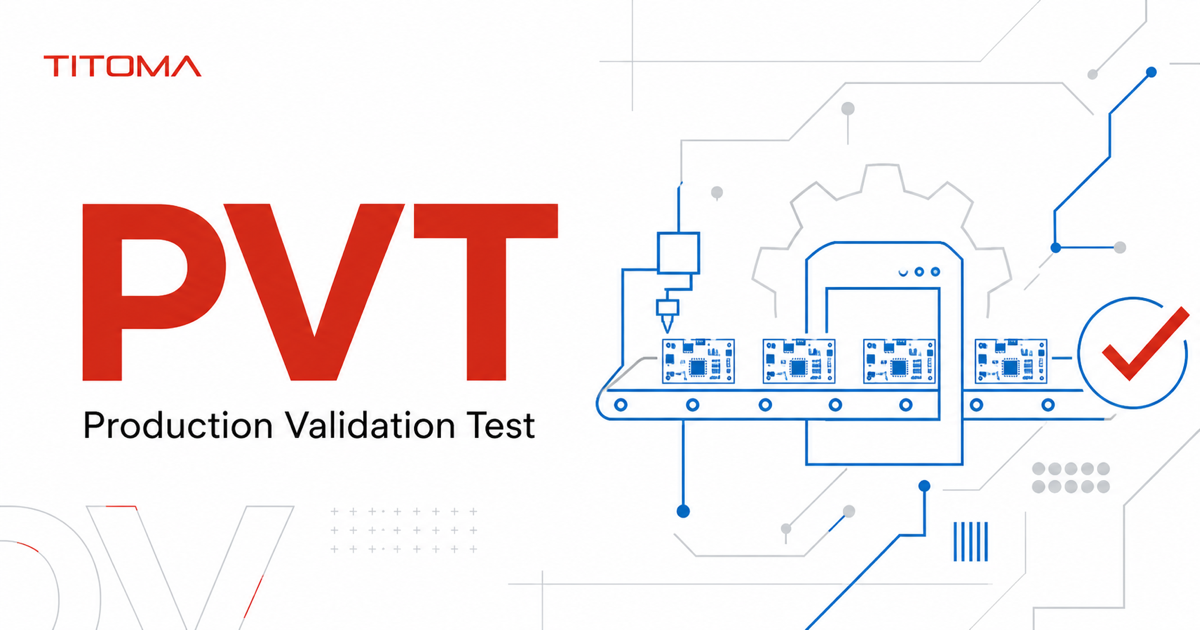
A Production Validation Test (PVT) confirms that a factory can build the final electronic product consistently with production tooling, trained operators, approved test fixtures, and documented quality controls. It takes place after Design Validation Test (DVT) and immediately before full mass production.
LIST OF PRODUCTION VALIDATION TEST ACTIVITIES
- Production line installation and setup
- Production line review and operator training
- Pilot production test using 5–10% of the first production run
- First Article Inspection (FAI) on production-intent PCB assemblies
- Outgoing Quality Control (OQC) and Final Quality Control (FQC)
- Functional test fixture and programming process verification
- Packaging validation for the gift box and master carton
- Cycle-time, yield, traceability, and work-instruction review
The Production Validation Test checklist is focused on the complete manufacturing system. The product design should already be locked, so the team is no longer proving that one unit can work. It is proving that the real SMT and assembly lines can build the same result repeatedly.
The pilot batch uses final components, tooling, fixtures, firmware-loading procedures, packaging, and quality criteria. The approved setup can become the “golden line” reference for the mass-production process.
HOW LONG DOES THE PRODUCTION VALIDATION TEST PROCESS TAKE?
Companies should allocate a minimum of 4 weeks for the Production Validation Test process. PVT is normally the shortest of the EVT, DVT, and PVT stages because the design, materials, and required certifications should already be settled before the pilot build begins.
A PVT manufacturing run commonly produces 5–10% of the first planned production order. The factory uses this batch to confirm line balance, assembly sequence, cycle time, yield, test coverage, operator instructions, quality records, and packaging.
The schedule can grow if the line produces unstable yields, test fixtures give inconsistent results, packaging fails transit testing, or inspectors find repeatable defects. These are process problems to correct before ramp-up, not an invitation to restart product design.
PVT VS DVT: WHAT’S DIFFERENT?
A Design Validation Test (DVT) proves that the production-intent design survives real-world conditions and meets its specifications. A Production Validation Test proves that the factory can build that locked design consistently at volume using the final production line and controls.
DVT is mainly product validation. PVT is process validation. Design changes are not expected during PVT; the work should focus on refining assembly, inspection, testing, traceability, and packaging.
