
Updated May 2026
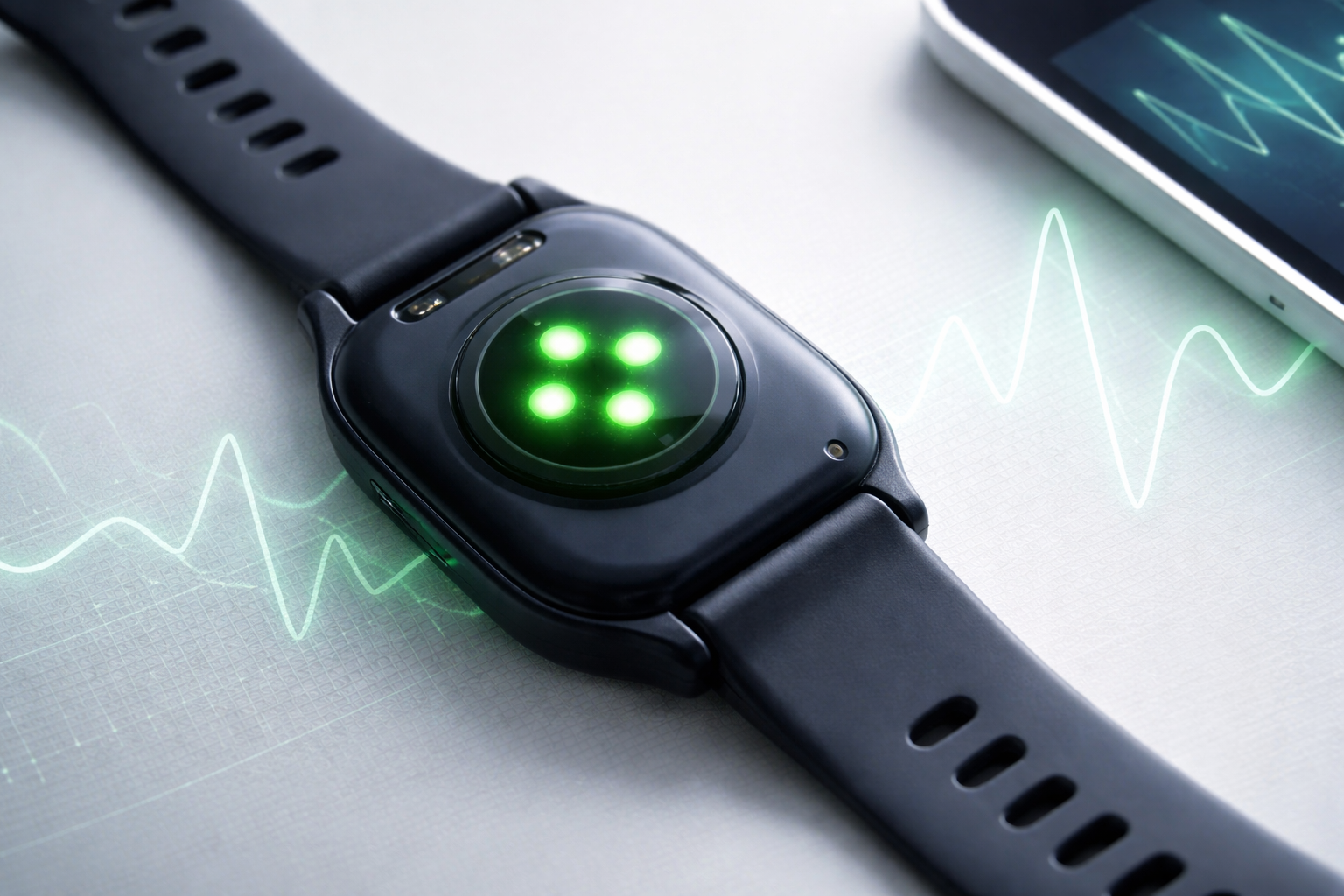
If you flip over a smartwatch, you will usually see a small green light flashing against the skin. That light is part of a PPG sensor, one of the most important sensors inside modern wearable devices.
PPG sensors allow wearables to measure heart rate and other physiological signals using light instead of electrodes. Today they appear in fitness trackers, smartwatches, wellness bands, and even some medical monitoring devices.
Wearables rely on many sensors working together. Motion sensors track movement, temperature sensors monitor environmental conditions, and optical sensors like PPG measure blood flow. If you want a broader overview of common hardware sensors used in electronics products, see our guide on the 6 essential sensors every engineer must know.
Understanding how PPG works is important not only for engineers building wearables, but also for anyone designing products that interact with the human body.
What Is a PPG Sensor
PPG stands for photoplethysmography.
It is an optical measurement technique that detects small changes in blood volume near the skin. A wearable device shines light into the skin and measures how much of that light is reflected back.
These small variations correspond to the pulse wave generated by the heart.
A simplified explanation looks like this:
- LEDs shine light into the skin
- Blood absorbs light differently than surrounding tissue
- Each heartbeat changes blood volume slightly
- The reflected light signal changes with the pulse
- The device converts that signal into heart rate data
If you want a deeper technical overview of wearable photoplethysmography systems, this research chapter on wearable PPG sensors explains the technology in more detail.
Why Wearables Use Green Light
Most consumer wearables use green LEDs for heart rate monitoring.
Green light is commonly chosen because it produces a strong signal when measuring blood flow at the wrist. The wavelength interacts well with blood vessels close to the skin surface.
This stronger signal makes it easier for algorithms to detect pulse patterns even when the user is moving.
Why Some Devices Use Red and Infrared
When a wearable attempts to estimate blood oxygen levels (SpO₂), it usually uses red and infrared LEDs.
These wavelengths interact differently with oxygenated and deoxygenated blood, allowing the device to estimate oxygen saturation.
This type of measurement is more complex and more sensitive to design errors. In fact, regulators have increasingly focused on accuracy concerns related to skin tone differences. The FDA has issued updated recommendations on pulse oximeter performance across skin tones.
The Hardware Inside a PPG Sensor Module
A wearable PPG system typically contains several electronic components working together.
Key elements include:
- LEDs that emit light into the skin
- A photodiode that detects reflected light
- An analog front-end that amplifies the signal
- A processor that analyzes the waveform
These parts are part of the broader electronics stack used in embedded systems. For a deeper look at the hardware building blocks used in electronics products, see our guide to 10 commonly used PCB components.
Why the Optical Stack Matters
Many engineers focus on the sensor chip, but the optical stack surrounding the sensor often determines performance.
Important design factors include:
- Sensor window material
- Window thickness and coatings
- Distance between LEDs and photodiode
- Ambient light shielding
- Mechanical contact with the skin
Even small changes in materials or coatings can affect signal quality. This is why optical components must be tightly controlled during product development and manufacturing.
Motion Artifacts: The Biggest Challenge for Wearables
Motion artifacts are the main reason wrist-based PPG sensors struggle during workouts.
When the device moves relative to the skin, the optical signal becomes noisy.
Common causes include:
- Micro-slippage between skin and sensor
- Changes in contact pressure
- Tissue deformation during motion
- Arm swing and vibration
- Ambient light leakage
Because of this, many wearables combine PPG data with accelerometer signals to filter motion noise.
Skin Tone and Signal Quality
Skin pigmentation affects how light is absorbed and scattered in tissue. This can influence signal quality and measurement accuracy.
For heart rate monitoring the effect is often manageable, but for oxygen saturation measurements the issue becomes more significant.
From a product design perspective:
- Devices should be validated across diverse skin tones
- Algorithms must handle different signal conditions
- Product claims must match real-world performance
Power Tradeoffs in Wearables
PPG sensors introduce important battery tradeoffs.
Higher LED brightness and faster sampling rates improve signal quality but increase power consumption.
Wearable designers often manage this using:
- LED duty cycling
- Adaptive sampling rates
- Signal quality detection
- Mechanical improvements to stabilize the sensor
Manufacturing Risks Engineers Often Miss
Some of the most common PPG problems show up only after a product enters manufacturing, not during design review.
Typical failure modes include:
- Window material changes that introduce optical haze
- Adhesive changes that cause internal reflections
- Tolerance shifts between sensor and window
- Poor strap fit on smaller wrists
- Condensation affecting optics
- LED variation between component batches
These issues highlight why design for manufacturing matters in hardware development. Catching them before tooling is committed is exactly what a prototyping pass is for.